Face Score Meaning and How It Is Calculated for Accurate Look Ratings
Discover what a face score means, how AI calculates it using symmetry, proportions, skin, and more to help you improve your look effectively.


Estimated reading time: 18 min
Key Takeaways
- A face score quantifies facial attractiveness based on symmetry, proportions, skin quality, and other core metrics, using AI measurements.
- AI employs landmark detection techniques combined with mathematical concepts like the golden ratio to analyze facial harmony and shape for scoring.
- Score scales vary, commonly ranging from 0–10 or 0–100, with average scores clustering around mid-range values; higher scores generally indicate stronger facial harmony.
- Photo quality factors such as lighting, camera angle, and facial expression influence face scores; optimizing these can affect results.
- Face score tools have limitations influenced by cultural diversity, photographic conditions, and AI model parameters; understanding these helps set realistic expectations and guides personal grooming and styling strategies.
Table of Contents
- Section 1: Understanding What a Face Score Means
- Section 2: Core Metrics Used in Face Scoring
- Section 3: The Golden Ratio and Facial Harmony
- Section 4: Face Shape Analysis and Its Impact
- Section 5: Skin Quality, Grooming, and Presentation
- Section 6: How AI Detects Facial Landmarks and Features
- Section 7: Interpreting Score Scales and What Is Considered Good
- Section 8: Improving Your Face Score Effectively
- Conclusion
- FAQ
Section 1: Understanding What a Face Score Means
Defining the Face Score Concept
A face score is a numerical value representing facial attractiveness, derived through analysis of various facial features and attributes using AI-powered tools. This score simplifies complex visual and structural information of the face into a single metric, reflecting perceived aesthetic appeal based on scientific and mathematical principles. The face score offers users an objective snapshot of facial harmony, symmetry, and skin condition, helping to understand personal facial strengths and areas that may benefit from enhancement or grooming.
Purpose and Use Cases
Applications like Maxx Report use face scoring to provide personalized glow-up plans, grooming suggestions, and style advice. These tools serve multiple purposes: from offering self-improvement pathways and boosting confidence, to optimizing dating profiles and enhancing professional images. For example, a user might receive skincare recommendations based on their skin quality score or hairstyle suggestions tailored to their face shape. The face score can also act as a baseline for tracking aesthetic progress over time, encouraging consistent self-care and informed decision-making.
How Face Scores Influence Perception
Facial attractiveness is subjective and shaped by cultural contexts and individual preferences, but face scores rely on universal principles—such as symmetry, proportionality, and skin health—to provide consistent, data-driven assessments. Understanding your face score can clarify some unconscious factors influencing how others perceive your appearance. For instance, a high symmetry score indicates balanced facial features, which some research associates with perceptions of health. Recognizing these factors can help users focus efforts on aspects likely to enhance social or professional impressions.
Section 2: Core Metrics Used in Face Scoring
Symmetry
Symmetry is considered an important component of facial attractiveness. AI algorithms evaluate symmetry by comparing the left and right sides of the face, measuring distances, angles, and relative positions of key facial landmarks such as the eyes, nostrils, mouth corners, and jawline. For example, if the distance between the eyes and the corners of the mouth is nearly identical on both sides, the face is deemed highly symmetrical. Some studies suggest faces with higher symmetry often receive higher attractiveness ratings, as symmetry may be associated with genetic health and developmental stability. Advanced AI tools can detect minute asymmetries, enabling nuanced scoring.
Proportions and Facial Thirds
Proportional harmony is assessed by dividing the face into vertical thirds and horizontal fifths, a method rooted in classical art and anatomy. Vertically, the face is segmented into three parts: from the hairline to the eyebrows, eyebrows to the base of the nose, and nose base to the chin. Horizontally, the face is divided into five sections, each roughly the width of one eye. AI measures the relative sizes of these segments, comparing them against established ideals. For instance, if the middle third (eyebrows to nose) is disproportionately larger than the other thirds, it may reduce the overall face score. These measurements help identify imbalances in facial structure, which can guide cosmetic or grooming interventions.
Jawline and Chin Definition
The jawline and chin contribute to perceived facial masculinity or femininity and overall attractiveness. AI evaluates the sharpness, angle, and contour of the jawline, as well as the prominence and shape of the chin. For example, a well-defined jawline with a clear mandibular angle (typically between 110 and 130 degrees) is often associated with attractiveness in men, indicating strength and maturity. Softer jawlines with rounded chins are generally preferred in female aesthetics, conveying youthfulness and approachability. The AI quantifies these nuances by analyzing angular relationships and contour gradients, assigning scores that reflect alignment with these ideals.
Eye Size, Shape, and Position
Eyes are pivotal in facial appeal. AI examines the size of the eyes relative to the face, shape (round, almond, hooded), and position, including interocular distance. For example, the “ideal” eye spacing is approximately one eye-width apart. The AI also assesses traits like the “Hunter eyes” look, characterized by deep-set, slightly hooded eyes with a horizontal gaze that conveys intensity and confidence. These subtle features can affect social perception and attractiveness. Eye symmetry and openness are also measured, as droopy or uneven eyes can lower scores.
Skin Quality
Skin condition is a critical factor in face scoring. AI-powered image analysis evaluates skin texture, clarity, pigmentation, and the presence of blemishes or wrinkles. For instance, smooth, even-toned skin with minimal pores and no visible acne or discoloration contributes positively to the score. The AI uses image processing to detect details like dryness, redness, or uneven pigmentation. Additionally, factors such as skin hydration and luminosity are indirectly assessed through image brightness and color balance. Improving skin quality through skincare routines can therefore have a positive effect on face scores.
Section 3: The Golden Ratio and Facial Harmony
What Is the Golden Ratio?
The golden ratio, approximately 1.618, is a mathematical constant historically associated with aesthetically pleasing proportions. In facial analysis, the golden ratio is used as a benchmark for harmonious proportions, where distances between various facial features approximate this ratio. For example, the ratio of the length of the face to its width, or the distance between the pupils relative to the width of the mouth, can be compared against the golden ratio. Faces whose proportions closely align with these ideals are often perceived as more attractive due to the subconscious appeal of mathematical harmony.
Applying the Golden Ratio to Face Scoring
AI algorithms utilize the golden ratio by calculating specific facial distances and comparing them to the ideal 1.618 proportion. Key measurements include:
- Ratio of nose width to mouth width
- Distance between pupils compared to the width of the face
- Length of the face relative to the distance from the forehead to the chin
- Height of the lips to the width of the nose
For instance, if the ratio of the distance from the upper lip to the chin compared to the mouth width closely approaches 1.618, the feature is considered harmonious. AI aggregates these individual ratios into an overall harmony score, which influences the final face score. This method provides an objective mathematical foundation, enhancing the precision of attractiveness assessments.
Limitations and Cultural Variability
Despite its utility, the golden ratio does not encompass the full spectrum of human beauty, which is diverse and culturally nuanced. Different ethnic groups and societies value varying facial features and proportions that may diverge from golden ratio norms. For example, certain cultures prize higher cheekbones or larger eyes relative to Western ideals. Therefore, modern face scoring systems integrate the golden ratio alongside other metrics and datasets representing diverse populations to avoid biased or overly narrow assessments. Users should be aware that a face score reflects a blend of universal and context-specific standards rather than an absolute beauty formula.
Section 4: Face Shape Analysis and Its Impact
Common Face Shapes
Face shapes are broadly categorized into types such as oval, round, square, heart, and diamond. Each shape presents unique contours and proportions that influence how individual facial features align and are perceived. For example:
- Oval: Characterized by balanced proportions with a slightly narrower jawline than the forehead.
- Round: Wider cheekbones with softer jawlines and less angularity.
- Square: Defined by a broad forehead and jawline with strong angles.
- Heart: Wider forehead tapering to a narrow chin.
- Diamond: Narrow forehead and jawline with wide cheekbones.
Understanding your face shape is essential in interpreting face scores, as scoring metrics adjust contextual expectations based on these structural differences.
How Face Shape Affects Scoring
AI systems classify face shape by analyzing the curvature and relative widths of the forehead, cheekbones, and jawline. This classification contextualizes other measurements, ensuring that, for example, a strong jawline is evaluated differently in a square face versus an oval face. A square face with a pronounced jawline may score higher in masculinity and attractiveness metrics, while the same jawline on an oval face could be considered less harmonious. This nuanced approach enhances the accuracy and personalization of the face score.
Personalizing Look Recommendations
Recognizing your face shape enables tailored styling and grooming advice, which can improve your face score and overall appearance. For instance, hairstyles that add volume on the sides can balance a long, oval face, while tapered cuts may soften a square jawline. Similarly, makeup contouring techniques vary by face shape to highlight or minimize certain areas. Tools like the Face Shape Quiz use AI to analyze your photo and deliver detailed face shape identification and corresponding personalized recommendations for grooming, hairstyling, and accessories.
Section 5: Skin Quality, Grooming, and Presentation
Role of Skin in Face Scoring
Skin quality is a major determinant in attractiveness, as it reflects health, youthfulness, and vitality. AI analyzes hydration levels (inferred through texture and reflectance), smoothness, pigmentation uniformity, and the presence of skin conditions such as acne, rosacea, or dark spots. For example, images showing oily or shiny skin might receive lower texture scores, while well-moisturized, matte skin scores higher. The AI also considers micro-wrinkles and pore visibility, which tend to increase with age. Regular skincare routines focusing on cleansing, moisturizing, and sun protection can lead to improvements in face scores over time.
Grooming Factors
Grooming encompasses facial hair management, eyebrow shaping, and overall hygiene, all of which impact facial definition and symmetry. For men with patchy beards, uneven facial hair can affect the perception of jawline sharpness, potentially lowering the score. The Ultimate Grooming and Skincare Guide provides advice including beard grooming techniques like trimming for shape, filling in sparse areas with cosmetic products, and maintaining skin health underneath facial hair. For women, eyebrow grooming shapes the eye area, enhancing expressions and balance. Clean, well-maintained skin and hair also contribute positively to the overall impression and AI analysis.
Impact of Presentation: Lighting, Angle, and Expression
Photo quality factors greatly affect AI’s ability to accurately assess facial features. Natural, diffused lighting minimizes harsh shadows and highlights, providing a more faithful representation of skin tone and contours. For example, front-facing daylight or soft indoor lighting is preferable to overhead fluorescent lights, which can cast unflattering shadows that distort perceived symmetry. Camera angle influences how features align; a straight-on or slight tilt angle helps capture facial symmetry best, while extreme angles can exaggerate asymmetries. Facial expression also matters — neutral or confident expressions show relaxed musculature and avoid distortions from smiling or frowning that may skew landmark positions. Optimizing these factors can improve the reliability and positivity of the face score.
Section 6: How AI Detects Facial Landmarks and Features
Landmark-Based Face Analysis
AI facial analysis begins with detecting key points known as facial landmarks, which map the structure of the face with precision. These landmarks include corners of the eyes, nostrils, mouth edges, chin tip, and jawline contours. By plotting these points, the AI creates a geometric representation of the face, allowing it to measure distances, angles, and proportions systematically. For example, the distance between the inner eye corners or the angle of the jawline can be calculated with millimeter accuracy. This process is foundational for subsequent scoring as it provides the raw data for symmetry, proportion, and shape analysis.
Number of Facial Points Detected
Depending on the sophistication of the AI model, the number of detected facial landmarks ranges from 68 (standard in many facial recognition systems) to over 400 in advanced models. More landmarks enable the AI to capture subtle asymmetries and detailed contours. For example, a 68-point model might detect the general shape of the lips and eyes, while a 400+ point model can analyze fine wrinkles, skin folds, and micro-expressions. This granularity translates into higher scoring accuracy and more personalized recommendations.
Integrating Multiple Feature Analyses
Landmark data is combined with other analytical inputs such as skin texture, color balance, and lighting adjustments to create a holistic face score. For instance, after mapping the facial geometry, AI algorithms perform texture analysis using convolutional neural networks to assess skin health. Color analysis corrects for lighting variations, ensuring that pigmentation measurements are accurate. The integration of these data streams allows the AI to weigh multiple attractiveness factors concurrently, providing a comprehensive and nuanced facial attractiveness score.
Section 7: Interpreting Score Scales and What Is Considered Good
Common Face Score Scales
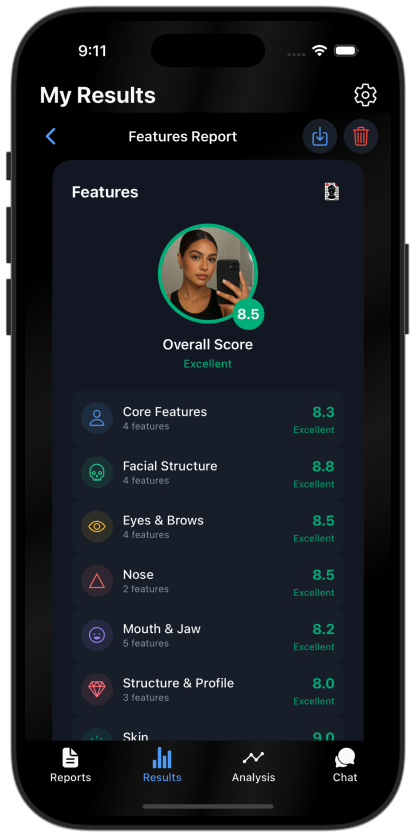
Face scores typically employ two main scales: a 0–10 scale and a 0–100 scale. The 0–10 scale is straightforward and user-friendly, providing an at-a-glance understanding of attractiveness levels. The 0–100 scale offers finer granularity, allowing for subtle differentiations between users who might otherwise cluster around the same score on the smaller scale.
What Counts as Average or High?
- 0–10 scale: Scores around 5 are considered average, representing typical facial harmony and feature alignment. Scores above 7 often reflect stronger symmetry, proportions, and skin quality.
- 0–100 scale: Scores between 50–65 generally correspond to average attractiveness, while scores exceeding 75 are seen as higher, suggesting strong facial harmony and feature presentation.
These thresholds are influenced by the datasets used to train the AI and the specific calibration of the model. For example, a dataset with a majority of young adults may have different scoring norms than one including a broad age range.
Reading Scores Realistically
Face scores should be interpreted as objective tools that provide directional insight rather than absolute judgments. They focus on measurable facial attributes but do not account for personality, charisma, style, or cultural beauty ideals fully. For example, a person with an average face score may still be perceived as highly attractive due to confidence and presentation. Thus, use face scores as a guide to inform self-improvement and grooming choices, but do not let them define your self-worth or social value.
Section 8: Improving Your Face Score Effectively
Optimizing Photo Quality
- Lighting: Use natural, diffuse lighting such as early morning or late afternoon sunlight. Avoid harsh direct light or shadows that exaggerate asymmetry or skin texture issues. If indoors, position yourself near a window with soft light.
- Angle: Capture photos facing the camera directly or with a slight tilt (up to 15 degrees) to present the most symmetrical and flattering perspective. Experiment with angles to find your best side, but avoid extreme tilts which distort proportions.
- Expression: Maintain a relaxed, neutral, or slight confident smile. Avoid exaggerated expressions like wide grins or frowns, as these can alter facial landmarks and reduce scoring accuracy.
- Camera Quality: Use high-resolution cameras that preserve detail necessary for skin and feature analysis. Clean lenses to avoid blurring or distortions.
Enhancing Facial Features
- Grooming: Develop a consistent grooming routine focusing on facial hair shaping, eyebrow maintenance, and skincare. For men, trimming or styling beards to accentuate the jawline can make a difference. Women can use makeup techniques to highlight or contour features harmoniously.
- Skincare: Adopt habits like daily cleansing, moisturizing, sun protection, and targeted treatments for blemishes or pigmentation. Over weeks to months, these can improve skin texture and evenness, positively influencing face scores.
- Hairstyle: Choose hairstyles that complement your face shape. For example, layered cuts can soften square faces, while volume on top may elongate round faces. AI fashion tools, such as the AI Fashion Consultant, can help identify optimal styles based on facial analysis.
Understanding Gender Differences in Scoring
Male and female facial attractiveness cues differ, and AI models are trained to recognize these distinctions. For instance, men typically score higher with defined, angular jawlines and prominent brows, features associated with masculinity. In contrast, females often benefit from softer, rounded contours, fuller lips, and larger eyes. Skin smoothness and even tone are universally valued but may be weighted differently. The AI adapts scoring algorithms accordingly to provide gender-appropriate assessments and advice, ensuring personalized and relevant recommendations.
Limitations and Consistency
Face scores may fluctuate between photos due to variations in lighting, angle, facial expression, and image resolution. Such inconsistencies are expected and highlight the importance of maintaining consistent photographic conditions for reliable tracking. Regularly updating your analysis using high-quality, standardized photos combined with following personalized recommendations from tools like Maxx Report promotes steady, measurable improvement. For practical strategies, explore AI Glow Up Tips That Work, which provide actionable steps grounded in data-driven insights.
Conclusion
Understanding what a face score signifies and the methodologies behind its calculation empowers users to make informed, strategic decisions regarding their appearance. By evaluating core metrics such as symmetry, proportions, skin quality, and face shape, AI-driven tools offer detailed, personalized insights into facial attractiveness that transcend subjective opinion. These scores serve not as absolute judgments but as starting points for effective glow-up strategies, enabling users to focus on areas with the highest potential for enhancement.
Leveraging applications like Maxx Report provides access to AI-powered facial analysis and tailored transformation plans. This fusion of technology and personalized self-care guidance facilitates meaningful improvements, helping individuals present their best selves confidently in personal and professional contexts.
FAQ
Q: How is a face score calculated?
A: A face score is calculated using AI that analyzes facial landmarks to assess symmetry, proportions, jawline sharpness, eye features, and skin quality. Mathematical models such as the golden ratio help quantify facial harmony, while texture analysis evaluates skin condition. These metrics are integrated into a unified score on scales like 0–10 or 0–100.
Q: What is a good face score?
A: On a 0–10 scale, scores above 7 are generally considered good, indicating above-average facial attractiveness. On a 0–100 scale, scores above 75 are often regarded as high. However, exact thresholds may vary depending on the AI system and its training data.
Q: Can you improve your face score?
A: Yes. Enhancing photo quality through better lighting and angles, adopting consistent grooming and skincare routines, and selecting styles suited to your face shape can improve your face score. Following AI-generated personalized recommendations supports sustained improvement.
Q: What features affect an AI face rating the most?
A: The most influential features for AI face scoring include facial symmetry, proportions based on metrics like the golden ratio, jawline definition, eye size and spacing, and skin quality factors such as texture and pigmentation.
Q: Are face score apps accurate?
A: Face score apps provide objective, data-driven assessments but have limitations. Their accuracy depends on photo quality, the sophistication of AI models, and cultural diversity in training data. They should be considered helpful tools rather than definitive judgments.
Q: Why does my face score change from photo to photo?
A: Variations in lighting, facial angle, expression, and image resolution can cause fluctuations in scores. To obtain consistent and reliable comparisons, maintain uniform photo conditions when retaking images for analysis.
Free to start
Try the Maxx Report app
Everything in this guide, in your pocket.
Get it on iPhoneGet it on Android