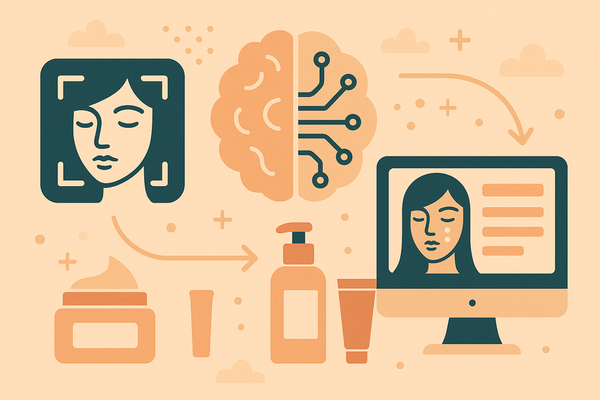
How AI Analyzes Your Features: A Deep Dive into Feature Extraction and Analysis
Explore how AI analyzes your features, transforming data through feature extraction and model training, and the future trends shaping personalized AI insights.

Estimated reading time: 8 minutes
Key Takeaways
- AI transforms raw data into meaningful features using techniques like PCA, CNNs, and TF-IDF.
- Feature extraction and selection optimize model performance for tasks from facial recognition to anomaly detection.
- Effective feature analysis improves accuracy, personalization, and computational efficiency.
- Challenges include bias, privacy, and regulatory compliance in handling sensitive features.
- Future trends point to automated feature engineering, edge AI, and advanced unsupervised methods.
Table of Contents
- Introduction
- 1. Understanding AI and Its Capabilities
- 2. How AI Analyzes Your Features
- 3. Benefits of AI in Feature Analysis
- 4. Challenges and Considerations
- 5. Future Trends in AI Feature Analysis
- Conclusion
- FAQ
Introduction
Artificial intelligence (AI) is the simulation of human intelligence in machines that learn, reason, and make decisions from data, illustrating exactly how ai analyzes your features. Feature analysis is the process of identifying and processing relevant characteristics—such as facial traits, behavior patterns, or digital footprints—to power predictions and personalization in algorithms. In this post, we’ll explain step by step how AI analyzes your features, why it matters across industries, and what challenges and future trends lie ahead.
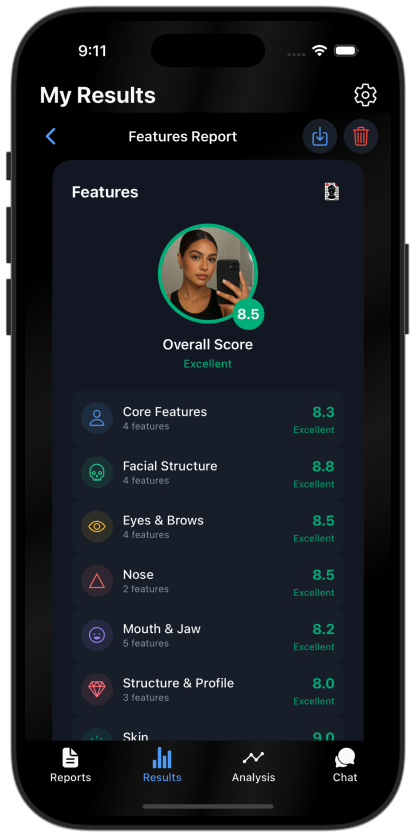
For a firsthand look at how AI breaks down facial characteristics, Maxx Report uses similar feature extraction techniques to deliver personalized beauty insights:
1. Understanding AI and Its Capabilities
AI encompasses machine learning (ML), which uses algorithms to learn patterns from data, and deep learning, which employs multi-layered neural networks for complex tasks. Key concepts include:
- Machine learning: Models learn from labeled or unlabeled data to drive recommendation engines, fraud detection, and more.
- Deep learning: Neural networks automatically learn hierarchical feature representations for image recognition, speech processing, and NLP.
- Features in AI: Measurable input properties—shapes and colors in images, words or phrases in text, or behavior data—simplified into vectors for efficient training (Wikipedia; Iterate.ai).
- Feature extraction vs. feature selection: Extraction creates new attributes (e.g., PCA, autoencoders), while selection picks relevant existing ones to reduce dimensionality and avoid overfitting (IBM).
2. How AI Analyzes Your Features
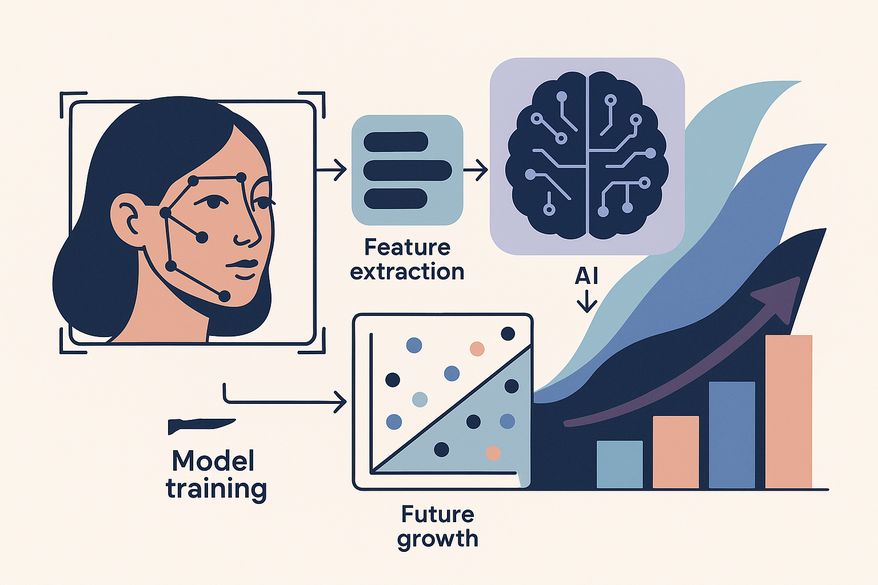
Systems typically follow four main steps:
- Data Collection: Sources include cameras, sensors, mobile apps, web logs, and medical devices. Quality and variety determine the richness of features (Atlas).
- Feature Extraction: Transforming raw data into machine-readable attributes using techniques like:
- Principal Component Analysis (PCA): Reduces dimensionality while preserving variance.
- Convolutional Neural Networks (CNNs): Extract spatial and texture features from images.
- TF-IDF: Quantifies word importance in text.
- Autoencoders: Unsupervised networks that learn compressed representations for anomaly detection.
- Model Training: Features feed into models like random forests, SVMs, or deep networks. Data splits tune hyperparameters and iterative optimization minimizes error (Zenoss).
- Analysis & Prediction: Trained models infer on new feature vectors for classification, regression, or clustering. Real-time inference or batch scoring yields actionable insights, with feedback loops for continuous improvement (GeeksforGeeks).
3. Benefits of AI in Feature Analysis
- Improved accuracy & efficiency: AI reduces noise and enhances precision over manual engineering (Flypix).
- Personalized outcomes: Tailored recommendations and treatment plans from user-specific feature profiles (Zenoss).
- Enhanced decision-making: Real-time risk scores and variant prioritization boost operational agility (Atlas).
- Reduced computational costs: Lower-dimensional features speed training and inference (Flypix).
4. Challenges and Considerations
- Bias & fairness: Skewed data can cause discriminatory outputs; proactive bias detection and balanced sampling are essential (Flypix).
- Privacy & ethics: Deep feature analysis raises consent and security concerns; transparent governance builds trust (Iterate.ai).
- Regulatory landscape: GDPR, CCPA, and AI governance frameworks mandate data minimization and explainability (Zenoss).
- Mitigation strategies: Use bias detection tools, anonymization, algorithmic audits, and document pipelines for traceability.
5. Future Trends in AI Feature Analysis
- Automated feature engineering: AutoML platforms reduce manual effort (Atlas).
- Real-time extraction & edge AI: On-device analysis for wearables and smart cameras (Flypix).
- Advances in unsupervised methods: GANs and self-supervised models learn richer representations (Iterate.ai).
- Sector-specific forecasts: Healthcare (multimodal imaging), retail (fused input personalization), finance (dynamic risk scoring).
Conclusion
We’ve explored the four steps of feature analysis—data collection, feature extraction, model training, and prediction—alongside benefits, challenges, and future directions. Understanding how AI analyzes your features empowers you to leverage accuracy gains and personalization while navigating ethical and regulatory landscapes. Explore ML courses, test feature engineering tools, and review data privacy to stay ahead.
FAQ
- What is feature extraction? Transforming raw data into machine-readable attributes, often via PCA, CNNs, or autoencoders.
- How does AI ensure fair feature analysis? Through balanced datasets, bias detection tools, and transparent governance.
- Why use automated feature engineering? To accelerate model development and reduce manual complexity.
- What role does edge AI play? Enables low-latency, on-device analysis for real-time insights without cloud dependency.