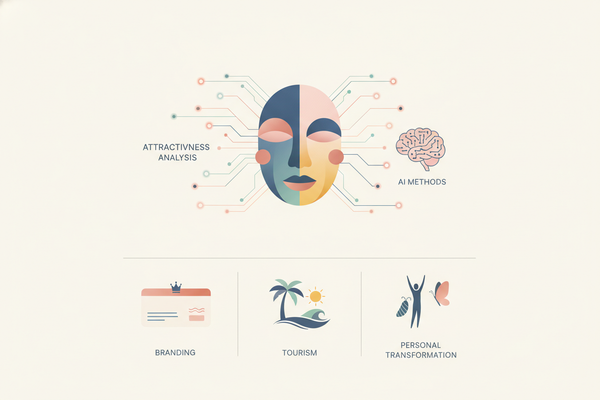
Asymmetrical Face App: How to Analyze and Improve Facial Symmetry
Discover how an asymmetrical face app uses AI to analyze facial features, score symmetry, and offer personalized glow-up plans for a balanced look.

Estimated reading time: 15 min
Key Takeaways
- An asymmetrical face app uses AI-driven facial landmark analysis to measure symmetry and rate individual features with precision.
- Accurate front-facing photos taken under proper lighting and angle conditions are important for reliable facial symmetry assessments and personalized transformation plans.
- Facial asymmetry is common and natural but can be analyzed in detail per feature: eyes, nose, lips, jawline, brows, and cheeks for better understanding and targeted improvements.
- Apps like Maxx Report provide golden ratio scores, 3D symmetry measurements, skin quality assessments, and personalized correction recommendations to help users enhance their appearance.
- Photo retouching, facial exercises, grooming adjustments, and skincare routines may help improve the appearance of asymmetry over time, supported by AI-driven feedback.
Table of Contents
- Section 1: Understanding What an Asymmetrical Face App Does
- Section 2: AI Facial Landmark Analysis and Symmetry Scoring Explained
- Section 3: Feature-by-Feature Breakdown of Facial Asymmetry
- Section 4: How to Take an Accurate Photo for Facial Symmetry Analysis
- Section 5: Using Mirror-Face and Split-Face Comparisons to Visualize Asymmetry
- Section 6: Beyond Symmetry: Beauty Scores, Golden Ratio, and Face Shape
- Section 7: Correcting Facial Asymmetry: Photo Retouching and Personalized Plans
- Section 8: Advanced 3D Symmetry Measurement and Medical Use Cases
- Conclusion
- FAQ
Section 1: Understanding What an Asymmetrical Face App Does
Defining Facial Asymmetry
Facial asymmetry refers to the differences and imbalances observed between the left and right sides of the face. These differences can manifest in various ways, such as variations in eye size, nostril width, lip shape, or jawline contour. Although perfect facial symmetry is extremely rare, minor variations are common and natural.
Facial asymmetry can be caused by genetic factors, developmental conditions, environmental influences, or habits such as sleeping predominantly on one side. Some asymmetries are subtle and purely cosmetic, while others may indicate underlying medical or dental issues.
An asymmetrical face app is a digital tool designed to analyze these facial differences by employing AI technology. These apps aim to quantify asymmetry, provide reports on which features deviate from symmetry norms, and offer guidance on potential cosmetic or corrective approaches.
The Core Functions of an Asymmetrical Face App
Such apps primarily function by scanning the user's face to identify a set of key landmarks—specific points on the face that correspond to anatomical features such as the corners of the eyes, tip of the nose, edges of the lips, jawline angles, and brow arches. Using these landmarks, the app performs measurements to determine the degree of asymmetry.
- Symmetry Scoring: The app calculates numerical values or percentages that reflect how balanced the face is overall. This score provides an objective metric for users to understand their facial symmetry level.
- Feature Rating: Beyond the overall score, the app breaks down asymmetry assessments for individual facial parts, allowing users to pinpoint specific areas, such as uneven eyebrows or a tilted jawline.
- Transformation Plans: Based on the analysis, many apps propose personalized recommendations. These might include skincare tips to address uneven skin tone, grooming advice to harmonize eyebrows or facial hair, facial exercises targeting muscle balance, or guidance on makeup and hairstyle adjustments.
Why Use an Asymmetrical Face App?
While some users engage with these apps out of curiosity, the benefits can extend beyond simple interest. They provide individuals with insights into the unique structure of their faces, which can be used to:
- Guide aesthetic decisions, such as choosing suitable hairstyles, makeup techniques, or grooming styles that complement facial features.
- Boost self-confidence by understanding and potentially improving facial harmony.
- Support professionals like orthodontists, cosmetic surgeons, or dermatologists in diagnosis, treatment planning, and monitoring progress.
- Track changes over time, such as those resulting from aging, weight loss, or cosmetic interventions.
Using an asymmetrical face app thus offers a combination of measurement and practical advice tailored to individual needs.
Section 2: AI Facial Landmark Analysis and Symmetry Scoring Explained
How AI Detects Facial Landmarks
Modern asymmetrical face apps use artificial intelligence, particularly convolutional neural networks (CNNs) and deep learning algorithms, to detect facial landmarks. These AI models are trained on datasets comprising annotated facial images, enabling them to generalize across diverse ethnicities, ages, and expressions.
The AI identifies coordinates for key facial points including:
- Inner and outer corners of the eyes — important for measuring eye size and alignment.
- Nose tip and nostrils — for assessing nasal deviation and balance.
- Lip edges, cupid’s bow, and corners — to analyze mouth shape and symmetry.
- Jawline contour points — to evaluate jaw angle and chin alignment.
- Eyebrow arches and tails — for measuring brow height and angle differences.
- Cheekbone prominences — to assess facial width and contour harmony.
These landmarks form a facial map, serving as the foundation for symmetry and proportion analyses.
Symmetry Scoring Algorithms
After establishing the landmarks, the app performs geometric measurements and calculations to quantify asymmetry. Typical metrics include:
- Horizontal distances between mirrored points on the left and right sides, such as the distance between the left and right pupils or mouth corners.
- Vertical alignment differences, including eye heights, eyebrow levels, and jawline slant, which can indicate tilts or unevenness.
- Angular deviations measuring the angles formed by features like brows, lips, and jawlines to detect rotational asymmetries.
- Proportional ratios comparing lengths and widths of features relative to each other and to overall face dimensions, often benchmarked against the golden ratio or classical aesthetic ideals.
These measurements are normalized and aggregated into an overall symmetry score, typically expressed as a percentage or numerical value. Additionally, per-feature scores allow users to understand which parts of their face contribute most to asymmetry.
Example: Maxx Report’s AI Approach
Maxx Report uses a proprietary AI system that integrates multiple data streams to deliver a facial analysis. Beyond symmetry, it includes skin quality assessments—evaluating texture, tone uniformity, and blemishes—and measures jawline sharpness, which affects perceived facial attractiveness.
The AI combines these variables into a multi-dimensional "looks rating," offering an evaluation that encompasses balance, skin health, and contour definition. This approach distinguishes Maxx Report from simpler symmetry-only apps by addressing multiple facets of facial aesthetics.
Moreover, Maxx Report updates its models using user feedback and new data, aiming to maintain accuracy and relevance across diverse populations.
Section 3: Feature-by-Feature Breakdown of Facial Asymmetry
Eyes
Eyes contribute significantly to facial expression and attractiveness. Eye symmetry involves parameters including:
- The alignment and height of eyelids, which affect perceived openness and alertness.
- The position and size of pupils, with differences potentially indicating neurological or muscular conditions.
- Eyebrow height and arch relative to the eyes, which influence facial expression and symmetry perception.
- Inter-pupillary distance, a key metric for eye spacing and balance.
Unequal eye size or vertical misalignment is a common asymmetry factor. For example, if one eye appears slightly higher or larger, the app quantifies these differences by calculating the pixel distance and angle between corresponding landmarks. Maxx Report can detect small differences, allowing subtle asymmetries to be highlighted.
Nose
Nasal asymmetry can manifest as:
- Deviation of the nasal bridge from the vertical midline, often visible as a crooked or tilted nose.
- Uneven nostril sizes or shapes, which may influence nasal breathing or aesthetics.
- Tip tilt, where the nose tip points slightly to one side or upwards/downwards.
The app analyzes the vertical midline based on facial landmarks such as the midpoint between the eyes and the center of the mouth, then measures lateral deviations of the nose tip and bridge. Horizontal widths at various nasal points are compared side-to-side to assess balance.
For instance, a deviation of a few millimeters in the nasal bridge is common and noticeable, and the app can highlight this with numerical feedback.
Lips and Mouth
Lip asymmetry is evaluated through:
- Fullness differences between the left and right sides.
- Height differences of the lip corners, which can affect perceived smile symmetry.
- Misalignment of the cupid’s bow, the double curve on the upper lip.
By landmarking the edges of the lips, mouth corners, and cupid’s bow, the app calculates vertical and horizontal offsets. For example, if one corner is higher than the other, the app flags this as mild asymmetry. Additionally, contour smoothness and volume can be assessed using shading and texture data.
Jawline and Chin
The jawline shape and chin position influence facial harmony. The app measures:
- Jaw contour points along the mandibular angle and lower face edge, assessing sharpness and symmetry.
- Chin center relative to the facial midline, detecting shifts that may create an unbalanced appearance.
- Angular measurements at the jaw’s corners to detect discrepancies in jaw width or prominence.
A symmetrical jawline often correlates with attractiveness; thus, the app provides feedback, such as identifying a chin deviation of a few millimeters or a softer jaw angle on one side.
Eyebrows and Cheeks
Eyebrow symmetry involves measuring:
- Height differences between the left and right brows.
- Arch shape and peak location, determining if one brow is more arched or flat.
- Distance between brows, which affects the perceived width of the upper face.
Cheekbone prominence and contour are assessed by analyzing landmark points on the malar eminences. The app compares cheekbone heights, widths, and curvature to detect imbalances that influence facial harmony and perceived youthfulness.
- Note: Minor asymmetry is natural and often contributes to an individual’s unique charm. The app aims to identify areas where subtle improvements or enhancements can be made, rather than enforcing unrealistic ideals.
Section 4: How to Take an Accurate Photo for Facial Symmetry Analysis
Lighting and Background
Proper lighting is important for the AI to correctly detect facial features without distortion. The ideal setup involves even, natural light that minimizes shadows and highlights. For example, taking photos near a window during daylight hours provides soft, diffused illumination.
Avoid harsh overhead lighting or side lighting that creates shadows across one side of the face, as these can skew landmark detection and symmetry calculations. Use a neutral, uncluttered background—such as a plain wall—to prevent distractions and allow the AI to focus on facial details.
Camera Position and Angle
The camera should be positioned directly in front of your face at eye level. Tilting your head up, down, or sideways introduces perspective distortions that will affect symmetry measurement accuracy. The phone or camera lens should be parallel to the face plane.
Using a tripod or stable surface helps maintain consistent positioning and prevents blur from movement. The distance between the camera and face should be sufficient to capture the entire face clearly, typically around 30-50 cm (12-20 inches), depending on the camera lens.
Expression and Preparation
Maintain a neutral expression with lips gently closed and eyes open, looking directly at the camera lens (not the screen). This standardizes facial muscle positioning for consistent analysis.
Remove glasses, hats, or heavy makeup that could obstruct or alter facial landmarks. If you normally wear makeup, opt for a light, natural look to avoid artificial changes in skin texture or color that might mislead the AI.
Tips for Best Results
- Use a smartphone with a high-resolution front camera (12 MP or higher recommended) to capture crisp details.
- Stabilize the phone using a tripod, selfie stick, or resting on a flat surface.
- Look directly into the camera lens rather than the preview screen to ensure accurate gaze alignment.
- Take multiple shots to select the sharpest and most neutral expression.
- Ensure the background contrasts gently with your skin tone without being too bright or dark.
- Clean the camera lens before shooting to avoid blurry or smudged photos.
Section 5: Using Mirror-Face and Split-Face Comparisons to Visualize Asymmetry
What Are Mirror-Face and Split-Face Techniques?
Mirror-face and split-face techniques are visualization tools that help users perceive facial asymmetry more clearly. They work by taking one half of the face and duplicating it to replace the opposite side, creating two composite images:
- One with the left half mirrored to form a full face.
- One with the right half mirrored likewise.
These images highlight how each side individually contributes to overall facial balance and reveal subtle asymmetries that are difficult to detect in normal photos.
How Apps Implement Mirror Comparisons
After AI facial landmark detection, apps like Maxx Report generate split-face images. The process involves:
- Identifying the facial midline based on key landmarks such as the nose bridge and philtrum.
- Extracting the pixel data from each half.
- Flipping and duplicating the left half to replace the right, and vice versa.
- Blending edges to create natural-looking composites.
These side-by-side images allow users to visually compare which side creates a more symmetrical or aesthetically pleasing appearance.
Benefits for Personal Assessment
- Visualizes subtle asymmetries that might be overlooked during casual observation.
- Helps users understand which features contribute to their unique look and which sides appear more balanced or attractive.
- Aids decision-making for makeup application (e.g., balancing eyebrow arches), grooming, or considering medical interventions.
- Increases self-awareness, allowing users to focus on areas with the greatest perceived imbalance.
- Supports tracking of progress over time if used regularly.
Section 6: Beyond Symmetry: Beauty Scores, Golden Ratio, and Face Shape
Incorporating the Golden Ratio
The golden ratio, approximately 1.618, is a mathematical proportion historically associated with aesthetic appeal and harmony in art, architecture, and human faces. Facial features that align with this ratio are often perceived as more attractive.
Asymmetrical face apps measure various facial proportions against the golden ratio, such as:
- Distance between eyes relative to face width.
- Length of the nose compared to mouth width.
- Ratio of forehead height to chin length.
For example, the ideal distance between the eyes is roughly equal to the width of one eye, and the length of the nose should be about the same as the distance between the eyes, both approximating the golden ratio. Deviations from these metrics affect the golden ratio score, contributing to an overall beauty assessment.
Beauty Score Integration
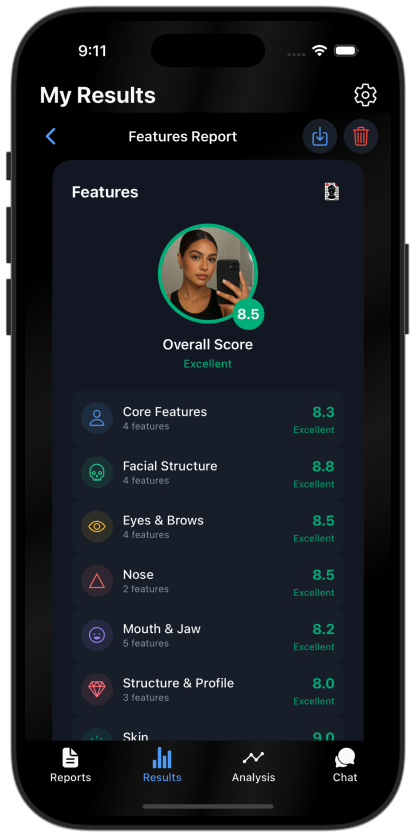
Apps like Maxx Report combine multiple factors into a beauty score that reflects more than just symmetry. These factors include:
- Symmetry percentages across all facial features.
- Skin quality metrics, such as evenness of tone, presence of blemishes, and texture smoothness.
- Jawline sharpness and contour definition, which influence perceived facial attractiveness and youthfulness.
- Proportion to golden ratio ideals.
This integrated score provides users with an understanding of their overall facial aesthetics, highlighting strengths and areas for improvement.
Face Shape Analysis
Understanding one’s face shape is fundamental for tailoring grooming, hairstyles, and makeup to enhance natural appearance. Common face shapes include oval, round, square, heart, and diamond, each with characteristic proportions and contours.
Maxx Report’s face shape analysis uses landmark data to classify the user’s face shape, considering parameters such as jaw width, cheekbone prominence, forehead width, and face length.
Knowing your face shape enables the app to recommend:
- Hairstyles that balance or accentuate your features.
- Makeup techniques to highlight or contour specific areas.
- Eyebrow shapes that harmonize with facial geometry.
For a detailed exploration, users can refer to the Face Shape Quiz blog post.
Section 7: Correcting Facial Asymmetry: Photo Retouching and Personalized Plans
Photo Retouching Tools
Many asymmetrical face apps integrate photo editing features that allow users to digitally adjust facial symmetry in images. These tools offer adjustments such as:
- Aligning eyebrow heights to create a balanced frame around the eyes.
- Smoothing uneven jawlines or reducing visible asymmetry caused by shadows or angles.
- Balancing lip shapes, fullness, or corner heights to improve smile symmetry.
- Refining nose shape or nostril sizes to reduce perceived deviation.
These retouching options are ideal for social media photos or confidence-boosting portraits, enabling users to preview potential changes before pursuing real-life interventions. However, these edits affect only images and do not alter the actual facial structure.
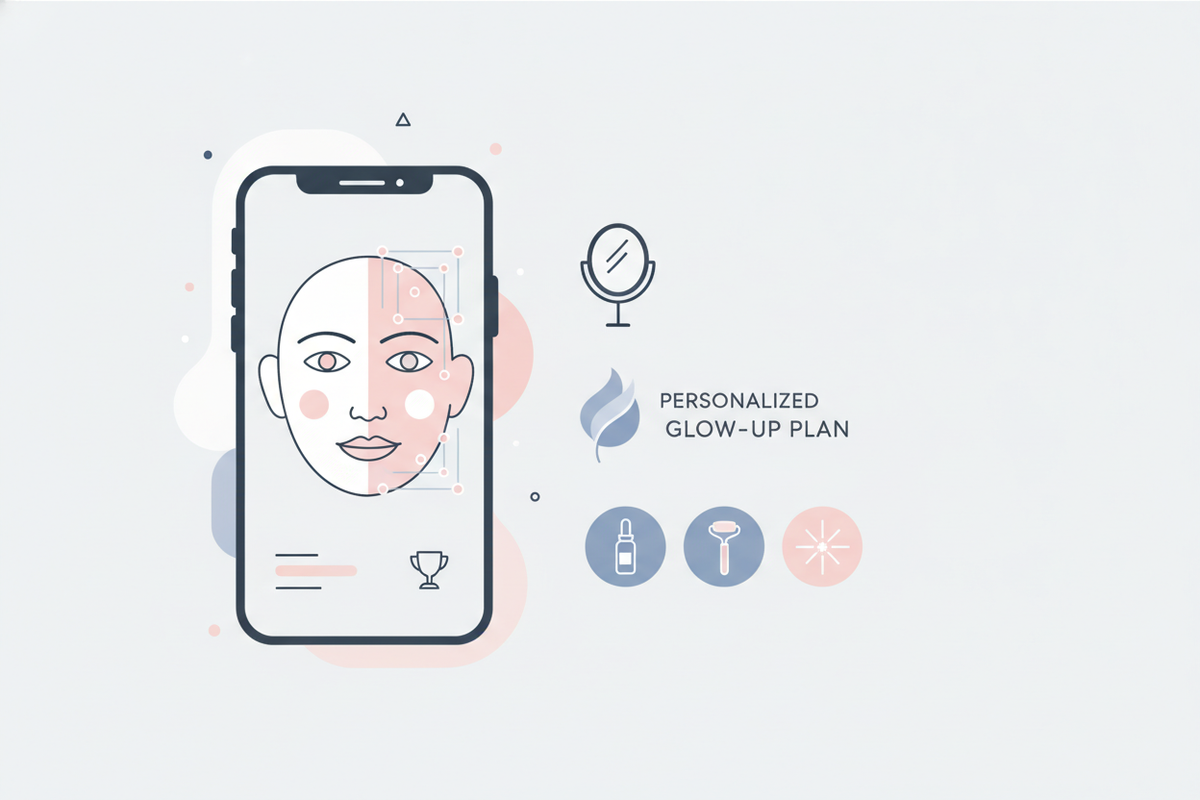
Personalized Glow-Up Plans
Maxx Report offers tailored transformation plans based on facial asymmetry and skin condition analyses. These plans are algorithmically generated and updated as users track progress. Components often include:
- Skincare routines: Targeting uneven skin tones, redness, or texture irregularities that can affect appearance.
- Facial exercises: Designed to strengthen underused muscles or relax overactive ones, potentially improving muscle balance and thus symmetry over time. Examples include targeted jawline exercises, eyebrow lifts, or cheek toning routines.
- Grooming tips: Recommendations for eyebrow shaping, beard trimming, or hairstyle adjustments to visually balance facial features.
- Makeup techniques: Contouring and highlighting strategies tailored to user's unique asymmetries and face shape.
These transformation plans adapt to changes in the user’s facial measurements or preferences. Users receive feedback and reminders to encourage adherence.
For more AI-driven beauty advice, explore the AI Glow Up Tips That Work blog post.
When to Seek Professional Help
While many asymmetries are mild and can be addressed cosmetically or with non-invasive methods, significant asymmetry may impact function (e.g., chewing, breathing) or cause psychological distress.
In such cases, consulting medical or dental professionals is advisable. Orthodontists can correct jaw misalignments, and plastic surgeons may offer procedures for nasal or facial contour correction.
Advanced 3D facial scans from apps or clinical imaging systems can assist professionals in pre-surgical planning and simulate expected outcomes, improving treatment precision and patient satisfaction.
Section 8: Advanced 3D Symmetry Measurement and Medical Use Cases
3D Facial Symmetry Technology
While traditional facial symmetry apps rely on 2D images, newer technology incorporates 3D scanning to capture the depth and contours of the face. This allows for more accurate and holistic symmetry assessment by including volumetric and curvature data.
3D scanning techniques used include structured light scanning, photogrammetry (combining multiple 2D images), and time-of-flight sensors. These methods generate detailed depth maps and surface models that capture:
- Precise depth coordinates of facial landmarks.
- Surface curvature, enabling detection of subtle bulges or depressions.
- Volume measurements, such as cheek fullness and jawline projection.
- Dynamic tracking of facial movements, useful for functional assessments.
This enhanced data allows apps to analyze asymmetry in three dimensions, detecting imbalances not visible in flat images.
Medical and Orthodontic Applications
3D facial symmetry data is valuable for clinical professionals. Applications include:
- Pre-surgical planning and simulation for plastic and reconstructive surgery, enabling prediction of post-operative outcomes and customized surgical guides.
- Tracking post-operative healing and monitoring changes over time to assess treatment efficacy.
- Designing personalized orthodontic devices or prosthetics that accommodate individual asymmetries.
- Assessment of craniofacial anomalies in pediatrics or trauma patients.
By integrating 3D facial data with patient records, clinicians can enhance diagnostic accuracy and optimize treatment plans.
Consumer Access to Advanced Features
Many asymmetrical face apps provide basic 2D symmetry scoring for free, while advanced 3D analysis and personalized transformation plans are often offered as premium features requiring subscriptions or in-app purchases.
Maxx Report balances accessibility with advanced capabilities by offering:
- Free basic symmetry analysis features to increase access.
- Subscription plans unlocking 3D facial scans, in-depth skin analysis, and comprehensive aesthetic recommendations.
- Regular updates improving AI accuracy and expanding feature sets.
This tiered approach enables users at different engagement levels to benefit from AI-powered facial analysis.
Conclusion
An asymmetrical face app can be a useful tool for those interested in understanding and enhancing their facial aesthetics. By leveraging AI-driven facial landmark detection, symmetry scoring, and personalized recommendations, users gain an objective picture of their unique facial features and potential steps to improve their look.
From accurate front-facing photo capture to advanced 3D measurements, these apps provide insights into eyes, nose, lips, jawline, brows, and cheeks individually. This granular approach allows users to appreciate their natural beauty and consider ways to enhance facial harmony through informed decisions.
Maxx Report combines symmetry analysis with skin quality evaluation, jawline contour assessment, and glow-up recommendations—all powered by AI. Explore how this app can support your personal style at Maxx Report.
FAQ
Q: How do I check facial asymmetry on my phone?
A: Use an asymmetrical face app like Maxx Report that employs AI facial landmark analysis. Take a clear, front-facing photo in good, even lighting with a neutral expression, then let the app scan your face to provide symmetry scores and feature breakdowns.
Q: Which app is best for face symmetry testing?
A: Maxx Report is among the well-regarded options due to its AI technology, analysis of multiple facial features, integration of golden ratio metrics, skin quality assessments, and personalized transformation plans.
Q: Can an app fix asymmetrical face in photos?
A: Many apps offer photo retouching tools that digitally adjust facial features to appear more balanced. However, these edits only affect photos and do not alter your actual facial structure.
Q: How accurate are face symmetry apps?
A: Accuracy depends on photo quality, lighting, and the sophistication of the app’s AI models. Apps like Maxx Report use trained neural networks and landmark detection, providing reliable symmetry scores especially when users follow recommended photo-taking guidelines.
Q: What causes facial asymmetry?
A: Causes include genetic predisposition, natural aging, habitual muscle use, injuries, dental or orthodontic issues, and environmental factors. Minor asymmetry is natural, but some habits or conditions can increase imbalance over time.
Q: Do face symmetry apps measure eyes, jaw, nose, and mouth separately?
A: Yes, advanced apps analyze each key facial feature individually to provide detailed asymmetry scores. This allows for personalized recommendations targeting specific facial areas to help users focus their improvement efforts.