
Attractiveness Rating: How It Works and What It Measures
Discover how attractiveness rating measures facial features, symmetry, and more with AI-powered insights to guide your personalized transformation plan.


Estimated reading time: 18 min
Key Takeaways
- Attractiveness rating attempts to quantify facial appeal using metrics such as symmetry, proportions (including golden ratio), skin quality, and other measurable facial markers.
- AI-powered face raters analyze features like jawline contour, canthal tilt, facial thirds, and micro-expressions to generate attractiveness scores aiming for objectivity and reproducibility.
- Ratings can differ by gender, culture, and subjective perception but often rely on standardized, measurable facial metrics to reduce variability and bias.
- Accurate attractiveness tests employ normalization techniques, large, diverse datasets, and contextual weighting to help minimize bias and improve reliability.
- Maxx Report offers an AI-driven attractiveness rating with personalized, data-backed glow-up plans to enhance your look based on detailed facial analysis.
Table of Contents
- Section 1: Understanding Attractiveness Rating and What It Measures
- Section 2: AI Face-Based Attractiveness Scoring Methods and Metrics
- Section 3: Key Facial Features Influencing Attractiveness Ratings
- Section 4: Calculating and Normalizing Attractiveness Ratings
- Section 5: Accuracy, Bias, and Ethical Concerns in Attractiveness Tests
- Section 6: Cultural, Gender, and Subjective Factors in Attractiveness Ratings
- Conclusion
- FAQ
Section 1: Understanding Attractiveness Rating and What It Measures
Defining Attractiveness Rating
An attractiveness rating is an attempt to quantify the often subjective and culturally influenced perception of facial appeal into an objective, numerical or categorical score. This score is designed to reflect how closely an individual's facial features align with commonly recognized standards of beauty, making it a tool for comparative analysis, self-assessment, and cosmetic enhancement planning.
Attractiveness ratings primarily focus on the face because it is a highly expressive and socially significant aspect of physical appearance, influencing first impressions and social interactions. By focusing on quantifiable traits, these ratings aim to reduce subjective variability and provide more consistent feedback.
What Attractiveness Ratings Measure
Attractiveness ratings assess a variety of measurable facial traits that contribute to perceived beauty. These include:
- Facial symmetry: The extent to which the left and right sides of the face mirror each other, which some research associates with genetic health and developmental stability.
- Proportionality: The alignment of facial features according to classical aesthetic principles such as the golden ratio (approximately 1.618), and the division of the face into vertical thirds (forehead, midface, lower face) and horizontal fifths (face width divided by eye width and spacing).
- Skin quality: Evaluation of skin texture, clarity, smoothness, even tone, and absence of blemishes or discolorations, which are often linked to youth and vitality.
- Feature prominence and harmony: The shape, size, and placement of key features such as jawline sharpness, cheekbone height, eye shape and canthal tilt (the angle of the eyes), nose shape, and lip fullness.
Observer-Rated vs. Self-Rated Attractiveness
Attractiveness can be assessed through two main lenses: self-ratings and observer ratings. Self-ratings are influenced not only by physical features but also by an individual's confidence, self-perception, psychological well-being, and cultural conditioning. These ratings can vary widely and may not always correlate with external perceptions.
Observer ratings, on the other hand, rely on visual cues and societal beauty standards, often reflecting collective cultural norms. AI-based systems like Maxx Report aim to approximate observer ratings by analyzing facial images using measurable parameters, thereby attempting to reduce subjective bias and increase reproducibility.
By providing a standardized framework for attractiveness measurement, these AI tools offer users insights that bridge subjective self-perception and broader social evaluations.
Section 2: AI Face-Based Attractiveness Scoring Methods and Metrics
How AI Evaluates Facial Attractiveness
Modern AI attractiveness rating systems leverage advances in computer vision, deep learning, and facial landmark detection to analyze facial images with precision. The process typically involves several steps:
- Facial landmark detection: Using algorithms such as convolutional neural networks (CNNs), the AI identifies key points on the face, including eyes, nose tip, mouth corners, jawline contour, and cheekbones.
- Geometric measurements: The AI calculates distances, angles, and ratios between these landmarks, such as interocular distance, nasal width, lip height, and jawline angles.
- Comparative analysis: These measurements are compared against datasets of facial images rated for attractiveness by human raters across demographics. The AI learns patterns correlating specific metric values with attractiveness scores.
- Texture and skin analysis: Through image processing techniques, the AI evaluates skin condition by assessing texture smoothness, pore visibility, blemishes, pigmentation unevenness, and color consistency.
Combining geometric and texture data allows AI to generate an attractiveness score that incorporates multiple dimensions of facial appeal.
Common AI Metrics for Attractiveness Rating
- Symmetry Score: Calculated by mirroring one half of the face and comparing it pixel-by-pixel to the other half, symmetry scores typically range from 0 to 100, where higher values indicate closer mirror-image similarity.
- Golden Ratio Compliance: By measuring ratios such as the width of the mouth to nose width, or the distance between pupils to face width, AI assesses how closely these align to the golden ratio (~1.618), historically linked to aesthetic harmony.
- Canthal Tilt: The angle formed between the inner and outer corners of the eyes relative to the horizontal plane. Positive canthal tilt (outer eye corner higher than inner) is often associated with youthfulness and attractiveness, often scoring between 10–15 degrees for higher ratings.
- Jawline Definition: Quantified by edge detection algorithms measuring the sharpness of the mandibular border and the angle between the chin and neck. Strong jawlines are often scored higher, especially in male faces, with angles typically between 110°–130° considered attractive.
- Skin Clarity Index: A composite score derived from texture analysis algorithms evaluating smoothness, spot detection, color uniformity, and pore size, often scored on a 0–100 scale.
Maxx Report’s Approach
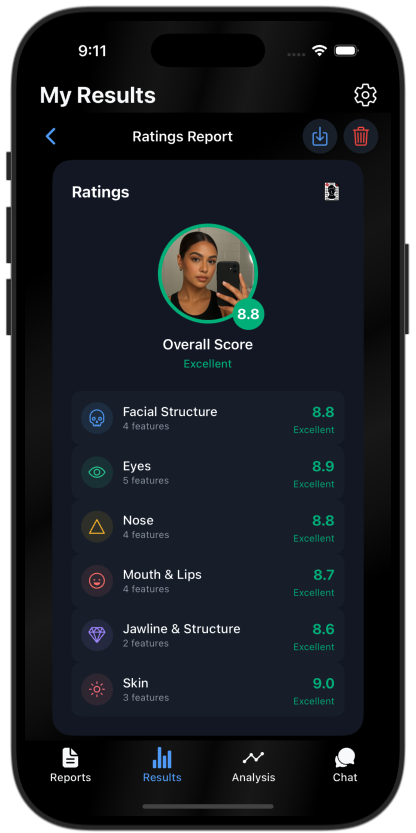
Maxx Report integrates these metrics into a multi-layered rating system that synthesizes individual feature scores using weighted algorithms calibrated through machine learning. Beyond scoring, it provides personalized, actionable glow-up plans tailored to each user's unique facial structure and skin condition.
For example, if the AI detects a low canthal tilt, Maxx Report may suggest makeup techniques or facial exercises to enhance eye shape perception. If skin clarity scores are low, it might recommend specific skincare routines or professional treatments.
This holistic approach transforms raw data into meaningful guidance, empowering users to make informed decisions about their appearance.
Section 3: Key Facial Features Influencing Attractiveness Ratings
Facial Symmetry
Facial symmetry is often considered a predictor of perceived attractiveness across cultures and genders. Symmetry is linked in some studies to developmental stability and genetic robustness, signaling health and fertility.
- Measurement: AI uses landmark-based algorithms to quantify symmetry at both macro and micro levels. For instance, it measures distances between bilateral landmarks (e.g., eye corners, nostrils) and assesses pixel-wise color and texture similarity between face halves.
- Impact: Some studies suggest faces with symmetry deviations greater than 2-3 mm may be rated less attractive. Maxx Report’s AI quantifies deviations down to sub-millimeter precision, aiming for detailed assessment.
Jawline and Chin
A well-defined jawline enhances facial structure by providing clear contours and balance. In men, a strong, angular jawline is often associated with masculinity and maturity, while in women, a softer yet well-contoured jawline is linked to femininity and youth.
- Sharpness and contour: AI analyzes the mandibular angle, jaw width relative to face width, and chin projection (how far the chin protrudes from the face plane). Ideal jaw angles for attractiveness typically range from 120° to 130° in men, and slightly softer in women.
- Balance: The chin’s vertical height and horizontal width are assessed for proportionality. A chin that is too recessed or overly prominent can affect overall harmony.
Golden Ratio and Facial Thirds
The golden ratio has been a foundation of aesthetic theory for centuries, and its application to facial proportions remains central in many attractiveness ratings.
- Golden Ratio: AI measures ratios such as the length of the nose to the distance between the eyes and the width of the mouth to the width of the nose. For example, the distance between the pupils compared to the width of the face ideally approximates 1:1.618.
- Facial Thirds: The face is divided vertically into three equal parts: hairline to eyebrow, eyebrow to base of the nose, and nose base to chin. Balanced thirds are often considered more attractive and correlate with perceived facial harmony.
Canthal Tilt and Eye Shape
Eye features are especially influential in attractiveness perception, conveying emotion, youth, and sociability.
- Positive canthal tilt: The outer corner of the eye being higher than the inner corner by about 10–15 degrees is often associated with higher attractiveness and perceived approachability.
- Eye size and spacing: Large eyes relative to face size, with ideal spacing roughly equal to the eye width, contribute positively to ratings.
- Eye shape: Almond-shaped eyes are often rated as more attractive compared to round or downturned eyes.
AI models analyze these subtle variations quantitatively, enabling nuanced attractiveness assessments.
Section 4: Calculating and Normalizing Attractiveness Ratings
Data Collection and Benchmarking
AI attractiveness systems like Maxx Report are trained on datasets containing large numbers of facial images, each annotated with human attractiveness ratings collected from diverse populations. This data diversity helps the AI learn patterns beyond narrow cultural or demographic biases.
Data collection protocols include ensuring standardized image conditions (e.g., frontal poses, neutral expressions, consistent lighting) and demographic metadata (age, gender, ethnicity) to enable stratified analysis.
Normalization Techniques
Raw AI measurements are subject to variability due to photo conditions and individual differences. Normalization techniques are important for producing reliable attractiveness scores:
- Score scaling: Feature measurements (e.g., jaw angle, symmetry) are scaled to a common numeric range (0–100) to enable aggregation.
- Contextual weighting: Certain features may have differing importance based on gender and age. For example, jawline sharpness may receive higher weight in male assessments, while skin clarity might be emphasized for younger female faces.
- Lighting and pose correction: AI algorithms adjust for shadows and slight head tilts that could distort measurements.
- Outlier handling: Extreme values caused by facial anomalies or image artifacts are identified and down-weighted to avoid skewing the overall score.
Composite Scoring
After normalization, individual feature scores are combined through weighted averaging or machine learning ensemble methods (e.g., random forests, gradient boosting), which model complex interactions between features. This composite scoring captures multidimensional aspects of attractiveness rather than relying on any single metric.
Distinguishing Face, Body, and Overall Appearance Ratings
While overall physical attractiveness incorporates body shape, posture, and style, facial features are often the most critical for first impressions and social judgments. Maxx Report specializes in face-based ratings, leveraging the rich data and scientific understanding of facial metrics to provide precise, actionable insights.
Body and overall appearance ratings are inherently more subjective and less amenable to automated analysis, requiring complementary tools and human judgment.
Section 5: Accuracy, Bias, and Ethical Concerns in Attractiveness Tests
Accuracy of AI Attractiveness Tests
The accuracy of AI-based attractiveness ratings depends heavily on the quality, size, and diversity of training datasets, as well as the sophistication of the underlying algorithms. Maxx Report employs deep learning models trained on tens of thousands of images representing various ethnicities, ages, and facial types to improve generalizability.
Validation studies suggest that AI ratings can correlate well with average human observer ratings, indicating generally reliable performance. However, AI is not flawless and may struggle with atypical or highly stylized faces.
Sources of Bias
- Dataset Bias: If datasets overrepresent certain groups (e.g., young Caucasian faces), AI models may underperform on underrepresented populations, resulting in biased scores.
- Cultural Bias: AI may internalize culturally specific beauty standards present in training data, leading to less accurate or unfair ratings when applied cross-culturally.
- Technical Bias: Variations in photo quality, lighting, facial expressions, and camera angles can affect feature detection and scoring.
Ethical and Privacy Considerations
Photo-based attractiveness testing raises important privacy concerns. Users must provide informed consent for image processing and storage. Maxx Report emphasizes strict data security protocols, transparency about AI methods, and user control over personal data.
Ethically, attractiveness ratings should avoid reinforcing harmful stereotypes or unrealistic beauty ideals. Maxx Report addresses this by providing constructive, personalized advice rather than judgmental scores, focusing on empowerment and self-improvement.
Furthermore, AI systems should be used as tools for self-awareness and enhancement, not as arbitrary arbiters of worth.
Section 6: Cultural, Gender, and Subjective Factors in Attractiveness Ratings
Gender Differences in Ratings
Male and female attractiveness ratings often prioritize different facial features, reflecting biological and social factors:
- Men: Greater emphasis is often placed on jawline sharpness, facial masculinity markers (e.g., brow ridge prominence), and overall facial symmetry. Strong jawlines and pronounced chin angles typically increase male attractiveness scores.
- Women: Skin smoothness, eye shape and size, lip fullness, and facial softness are weighted more heavily. Subtle facial contours and balanced proportions often enhance female attractiveness ratings.
Maxx Report’s AI adapts its weighting schemes accordingly to generate gender-appropriate assessments and recommendations.
Cultural Influences
Beauty standards vary widely across cultures. For example:
- Some East Asian cultures prize a V-shaped jawline and pale, flawless skin.
- Western cultures often emphasize high cheekbones and tanned, healthy skin.
- Other cultures may value distinctive nose shapes, fuller lips, or specific eye shapes.
Understanding these differences, Maxx Report incorporates multicultural datasets and allows users to select cultural contexts or preferences to tailor ratings and advice, making the system more inclusive and relevant globally.
Subjectivity and Personal Preferences
Despite objective metrics, attractiveness remains partly subjective. Individual preferences influenced by personal experiences, media exposure, and interpersonal dynamics mean that no rating can fully capture personal taste.
AI systems like Maxx Report provide a scientific baseline grounded in empirical research but encourage users to interpret results as guidance, not definitive judgments. This approach fosters a healthy balance between data-driven insights and self-expression.
Conclusion
Attractiveness rating is a complex, multi-dimensional evaluation blending measurable facial metrics with cultural and subjective factors. AI-powered tools analyze symmetry, the golden ratio, jawline, skin quality, and subtle facial angles to produce objective scores that can guide personalized appearance improvement.
Understanding how these ratings work demystifies the process, enabling users to leverage insights effectively. Maxx Report exemplifies this by offering an AI-driven attractiveness rating system combined with tailored glow-up plans, helping users enhance their look based on detailed facial analysis.
By combining scientific metrics with ethical AI practices and cultural sensitivity, attractiveness ratings can serve as empowering tools for personal transformation rather than mere judgment.
FAQ
Q: How is an attractiveness rating calculated?
A: Attractiveness ratings are calculated by analyzing facial symmetry, proportions like the golden ratio, jawline definition, eye shape (including canthal tilt), and skin quality using AI models trained on large, diverse datasets of rated faces. Each feature is scored individually, then combined through weighted algorithms into a composite score reflecting overall facial appeal.
Q: What facial features affect attractiveness ratings the most?
A: The most influential features often include facial symmetry, jawline sharpness and contour, proportional balance of facial thirds, canthal tilt (the upward angle of the eyes), eye size and spacing, and skin clarity. These features are linked to perceptions of health, youthfulness, and genetic fitness.
Q: Are AI attractiveness tests accurate?
A: AI tests provide consistent and objective assessments that can correlate strongly with human ratings when trained on large, diverse datasets. While not perfect, advanced AI systems like Maxx Report's analyze multiple facial metrics and apply normalization techniques to deliver reliable, reproducible attractiveness scores.
Q: Why do different people rate attractiveness differently?
A: Attractiveness is partly subjective, influenced by personal preferences, cultural norms, and individual experiences. Different observers may emphasize different facial features or styles, leading to variation in ratings. AI systems provide a baseline informed by scientific principles but cannot capture all subjective nuances.
Q: What is a good attractiveness rating score?
A: Good scores vary by rating system, but generally, higher scores indicate facial features closer to scientific ideals like symmetry and golden ratio compliance. Scores above the mean (e.g., >70/100) typically signal higher perceived attractiveness, though personal and cultural perceptions may differ.
Q: Do attractiveness ratings vary by gender or culture?
A: Yes. Gender influences feature weighting (e.g., jawline prominence is often more valued for men, skin softness for women). Cultural differences affect preferred traits, so AI models incorporate diverse datasets and allow customization to reflect global beauty standards more accurately.