
Attractiveness Scale Meaning, Color, Tone & How to Identify It
Learn what an attractiveness scale means, how AI rates faces, key criteria, photo tips, and reliability of 1-10 attractiveness scores.


Estimated reading time: 15 min
Key Takeaways
- The attractiveness scale typically rates facial appeal from 1 to 10 based on factors such as symmetry, skin quality, jawline, and facial thirds, providing a standardized, quantifiable measure used in various contexts.
- AI-powered attractiveness tests analyze photos using facial landmarks and algorithms that consider symmetry, proportion, and texture metrics to generate scores.
- Reliable ratings depend on aggregation from multiple raters or AI consensus models rather than a single opinion, which can help enhance consistency and reduce subjective bias.
- Choosing the right photo—with good natural lighting, a neutral expression, a frontal angle, and minimal makeup or obstructions—can improve rating accuracy.
- Facial attractiveness, beauty, handsomeness, and cuteness are related but distinct concepts, each measured differently and weighted variably in scoring systems.
Table of Contents
- Section 1: Understanding the Attractiveness Scale and Its Meaning
- Section 2: How Online Attractiveness Tests Score Faces and Photos
- Section 3: Common Rating Criteria in Attractiveness Scoring
- Section 4: The Role of Multiple Raters vs. Single Rater in Scoring
- Section 5: Choosing the Best Photo for Attractiveness Testing
- Section 6: Psychometrics, Reliability, and Validity of Attractiveness Ratings
- Section 7: Differentiating Facial Attractiveness, Beauty, Handsomeness, and Cuteness
- Section 8: How Attractiveness Scales Are Marketed and Interpreted
- Conclusion
- FAQ
Section 1: Understanding the Attractiveness Scale and Its Meaning
Defining the Attractiveness Scale
The attractiveness scale is a numeric system designed to quantify facial appeal on a standardized range, most commonly from 1 to 10. This scale functions as a simple, digestible metric to express subjective perceptions of physical attractiveness in an objective-seeming format. It can be employed by individuals seeking feedback, researchers studying human aesthetics, or AI-powered apps aiming to provide actionable insights.
Each integer value on the scale corresponds to a general level of perceived attractiveness, usually anchored by qualitative descriptions. For example, a rating of 1 indicates a lower level of facial appeal, often associated with noticeable asymmetry, skin issues, or disproportional features, whereas a 10 represents a high level of attractiveness, reflecting facial harmony and skin condition.
This scale is implemented in various contexts, including psychological research, dating platforms, and AI-driven beauty and transformation applications like Maxx Report, where it serves as a foundation for personalized improvement recommendations.
What Do The Numbers Actually Mean?
Interpreting numbers on the attractiveness scale requires understanding that these scores are relative rather than absolute truths. They provide an approximate position on a continuum of facial appeal rather than definitive judgments. Typical interpretations include:
- 1-3: Lower attractiveness, often reflecting noticeable facial asymmetry, skin imperfections (e.g., acne, scars), or atypical proportions that deviate from classical standards.
- 4-6: Average attractiveness, representing many individuals with balanced but not outstanding features.
- 7-8: Above average attractiveness, often linked to balanced facial features, symmetry, and healthy skin tone.
- 9-10: High attractiveness, generally less common, indicating facial harmony, proportions close to classical ideals, and good skin quality.
For example, a 7 on an attractiveness scale typically suggests a face that is visually appealing and above average but does not necessarily reach idealized beauty standards. Such a score might represent a well-defined jawline, symmetrical eyes, and clear skin, though not necessarily flawless.
Why Use an Attractiveness Scale?
The attractiveness scale provides a quick, intuitive way to communicate appearance feedback. It simplifies the complex and multifaceted nature of physical beauty into a single metric that is easy to understand and compare. For AI-based applications like Maxx Report, this scale powers personalized transformation plans by identifying baseline attractiveness scores and tracking progress over time.
Moreover, the scale serves as a common language in research to quantify facial appeal and enable statistical analysis, facilitating studies on how attractiveness correlates with social outcomes, confidence, or health indicators.
By distilling subjective judgments into numerical data, the attractiveness scale bridges human perception and technological analysis, allowing for actionable insights and objective feedback loops.
Section 2: How Online Attractiveness Tests Score Faces and Photos
AI Facial Recognition and Landmark Detection
Online attractiveness tests harness AI technologies to analyze facial features. The core process begins with facial landmark detection, which identifies key points on the face, such as the corners of the eyes, the tip of the nose, the edges of the mouth, cheekbones, and jawline. These landmarks form the basis for measuring distances, angles, and symmetry.
Once landmarks are detected, algorithms perform several calculations:
- Symmetry analysis: The left and right sides of the face are compared by measuring the distances between corresponding landmarks. For example, the distance from the left eye corner to the nose tip is compared with the right eye corner to the nose tip, assessing how closely mirrored the halves are.
- Proportion calculations: The face is divided into vertical and horizontal thirds — forehead to eyebrows, eyebrows to nose base, and nose base to chin — and these segments are compared against the golden ratio (approximately 1:1.618). The closer the ratios align to this standard, the higher the perceived attractiveness.
- Skin texture assessment: Using image analysis, AI detects blemishes, wrinkles, uneven pigmentation, and pore visibility. Texture smoothness and uniform tone typically increase attractiveness scores.
These processes allow the AI to generate a profile of facial aesthetics, quantifying elements that humans perceive subconsciously.
Data-Driven Scoring Systems
While geometric measurements are fundamental, AI scoring models also rely on datasets of faces rated by human judges. Machine learning algorithms are trained on these datasets to recognize patterns and features that correlate with higher attractiveness ratings. This training allows AI to incorporate nuanced visual cues beyond simple geometry, such as expressions, subtle asymmetries, and skin vibrancy.
For example, a convolutional neural network (CNN) trained on many labeled images can learn that certain eye shapes or cheekbone prominence are typically favored, adjusting scoring weights accordingly. This results in more accurate and human-aligned attractiveness scores.
Visual Representation of Ratings
Apps like Maxx Report display attractiveness scores in a transparent and user-friendly manner. Rather than presenting a single aggregate number alone, they often break down the rating into subcategories highlighting specific facial traits. This granularity empowers users to understand which aspects contribute most positively or negatively to their overall score.
For example, the Maxx Report rating screen includes detailed scores for:
- Jawline strength and contour
- Facial symmetry percentage
- Skin quality index (based on texture and tone)
- Facial proportions relative to golden ratio standards
Below is an example screenshot from Maxx Report showing detailed ratings:
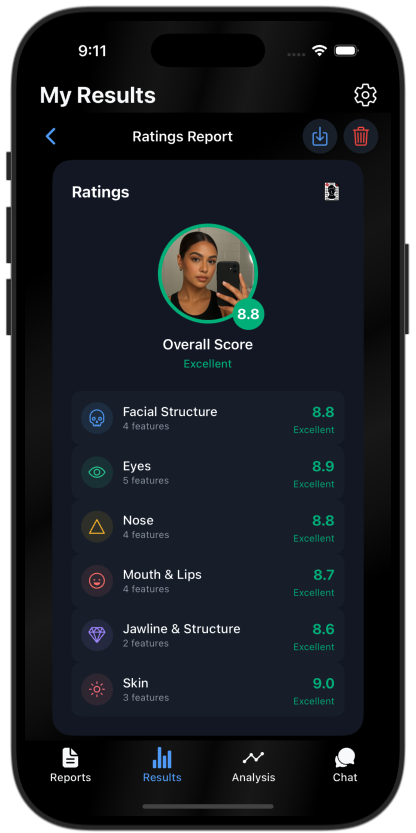
This multi-dimensional feedback allows users to target specific areas for improvement, making the attractiveness scale not just evaluative but also prescriptive.
Section 3: Common Rating Criteria in Attractiveness Scoring
Facial Symmetry
One of the most researched and influential factors in facial attractiveness is symmetry. Symmetry refers to how closely the left and right halves of the face mirror each other. High facial symmetry is often associated with genetic fitness and developmental stability, making it a predictor of perceived beauty.
In practical terms, AI measures symmetry by calculating the distances between matching landmarks on each side and quantifying the percentage of deviation. For example, a deviation of less than a few percent is often considered highly symmetrical. Faces with symmetry scores above 85-90% tend to score higher on attractiveness scales.
However, perfect symmetry is rare and sometimes perceived as unnatural. Slight asymmetries can contribute to character and individuality, so AI models typically weight symmetry moderately rather than absolutely.
Jawline Definition
A well-defined jawline is associated with attractiveness, especially in male faces, where it signals masculinity and strength. In females, a gently contoured jawline can indicate youth and femininity.
AI algorithms assess jawline sharpness by analyzing the angle formed between the chin and the jaw edges, as well as the contrast between the jawline and the neck in the photo. A jaw angle close to 120 degrees is often considered ideal in men, while slightly softer angles are preferred for women.
For example, a sharply defined mandibular angle and a pronounced chin tend to increase attractiveness scores compared to less defined jawlines.
Skin Quality
Skin quality encompasses texture, tone, clarity, and the presence or absence of blemishes. AI tools use image processing techniques to detect:
- Acne, scars, or pigmentation irregularities
- Wrinkles or signs of aging
- Overall smoothness and evenness of skin tone
Clear, smooth, and uniformly toned skin is generally favored and can boost attractiveness scores by improving perceived health and youthfulness.
Quantitatively, skin quality indices may range based on pixel-level analysis, with higher scores indicating better skin condition.
Facial Thirds and Proportions
Measuring the face in vertical thirds—forehead to eyebrows, eyebrows to nose base, and nose base to chin—helps evaluate facial harmony. The golden ratio (approximately 1:1.618) serves as a classical standard of beauty, where these thirds ideally follow this proportion for maximum appeal.
- For example, if the forehead measures 6 cm, the midface might ideally be approximately 9.7 cm, and the lower face about 15.5 cm to align with golden ratio principles.
- Deviations greater than 15% from these ratios may reduce attractiveness scores noticeably.
AI tools measure these distances using landmark coordinates and calculate ratios automatically, providing feedback on which facial sections might benefit from cosmetic or grooming adjustments.
Section 4: The Role of Multiple Raters vs. Single Rater in Scoring
Why Multiple Raters Matter
Attractiveness is inherently subjective, influenced by personal preferences, cultural backgrounds, and situational contexts. Consequently, ratings based on multiple independent raters tend to be more reliable and valid than single-person judgments.
Multiple raters help average out individual biases, moods, and idiosyncrasies, leading to a consensus score that better reflects general societal perceptions. For example, psychological studies often use ratings from multiple individuals to achieve stable attractiveness estimates with acceptable inter-rater reliability.
In AI applications, training datasets often include thousands of faces rated by multiple people to ensure robust learning and consensus modeling.
Single Rater Limitations
Ratings from a single individual are susceptible to:
- Personal taste and emotional state
- Contextual factors like lighting or mood
- Cultural or gender biases
These factors can result in inconsistent and less generalizable scores, limiting their usefulness for objective feedback or research.
AI as an Aggregate Rater
AI attractiveness scoring tools like Maxx Report approximate the effect of multiple raters by learning from large, diverse datasets containing multiple human judgments per face. This allows AI to approximate a consensus rating rather than a single subjective opinion.
Furthermore, AI models incorporate psychometric principles to ensure consistency and reduce noise, such as weighting features according to their predictive power and calibrating outputs against benchmark ratings.
This approach results in objective, reproducible, and scalable scoring that can be delivered instantly to users worldwide.
Section 5: Choosing the Best Photo for Attractiveness Testing
Lighting and Clarity
Lighting quality is one of the most critical factors influencing the accuracy of AI attractiveness assessments. Ideally, photos should be taken in natural, diffuse lighting conditions, such as near a window on a cloudy day or in shaded outdoor areas to avoid harsh shadows or overexposure.
Good lighting reveals subtle skin details and facial contours without obscuring them. Avoid:
- Backlighting that causes silhouette effects
- Harsh direct sunlight that creates strong shadows
- Artificial lighting with color casts (e.g., yellow or green hues)
Additionally, images must be sharp and high-resolution to allow AI algorithms to accurately detect fine details like pores and wrinkles. Blurry or pixelated photos degrade scoring accuracy significantly.
Neutral Expression and Angle
A neutral facial expression—relaxed mouth, no exaggerated smiles or frowns—provides a stable baseline for analysis. Expressions can distort facial landmark positions and proportions, introducing noise into symmetry and proportion calculations.
The best angle is a straight-on frontal shot, where the face is centered and looking directly at the camera. This perspective minimizes perspective distortion and facilitates accurate bilateral comparisons.
Profiles or angled photos are generally not suitable for standardized attractiveness testing because they obscure one side of the face and distort proportions.
Minimal Makeup and Obstructions
Makeup, facial hair, accessories (glasses, hats, jewelry), and hairstyles covering the face can interfere with landmark detection and skin analysis. Excessive makeup may mask blemishes or alter perceived skin tone, while facial hair can obscure jawline contours.
For the most precise and consistent results, it is recommended to use a clean face image with hair pulled back and no obstructions. This ensures the AI can analyze underlying facial features accurately.
Following these photo guidelines—good natural lighting, neutral expression, frontal angle, and minimal obstructions—can maximize the reliability and helpfulness of attractiveness ratings and the personalized recommendations that follow.
Section 6: Psychometrics, Reliability, and Validity of Attractiveness Ratings
Response Scales and Measurement Precision
The common 1–10 attractiveness scale is intuitive and easy to use, but it inherently limits the granularity of measurements. Psychometric research indicates that human perception of attractiveness is a complex, multi-dimensional construct that does not always map neatly onto a single numeric scale.
Small differences between adjacent scores (e.g., 6 vs. 7) may not reflect meaningful perceptual distinctions. To address this, some studies employ finer-grained rating systems or continuous scales, but these are less practical for consumer apps.
Thus, the 1–10 scale should be understood as a heuristic tool that balances simplicity with reasonable differentiation.
Inter-Rater Agreement and Consistency
Scientific studies on facial attractiveness report moderate to high inter-rater reliability (correlations typically between 0.7 and 0.9) when standardized protocols are applied. Consistency improves with the number of raters and clearer rating instructions.
AI models trained on such reliable datasets can replicate these consistencies, producing scores that correlate well with average human judgments.
Limitations and Biases
Despite efforts to standardize, attractiveness ratings are influenced by:
- Cultural norms: Standards of beauty vary across cultures and ethnicities, affecting how features are weighted.
- Gender biases: Desirability of traits differs for males and females, e.g., strong jawlines favored in men but less so in women.
- Contextual factors: Clothing, grooming, and environmental cues can alter perceptions.
Scientific approaches attempt to control for these variables using diverse datasets and demographic balancing, but perfect objectivity is unattainable.
Therefore, attractiveness scales are best viewed as useful guides rather than absolute judgments, meant to inform and inspire rather than label or limit.
Section 7: Differentiating Facial Attractiveness, Beauty, Handsomeness, and Cuteness
Facial Attractiveness vs. Beauty
Facial attractiveness is a broad term encompassing physical traits generally perceived as appealing, including symmetry, proportions, and skin quality. It quantifies visual appeal in a measurable way.
Beauty, on the other hand, often refers to culturally defined ideals that may include subjective elements such as style, expression, and charisma. Beauty is more fluid and context-dependent than pure attractiveness.
Handsomeness and Cuteness
Handsomeness typically describes masculine traits such as a strong jawline, pronounced brow ridges, and angular facial features. Handsome faces often score higher on attractiveness scales focused on masculinity.
Cuteness emphasizes youthfulness, rounder features, large eyes relative to face size, and softer contours, traits often associated with children or youthful adults. Cuteness scores may rely more on features like eye size and cheek fullness than symmetry.
Implications for Scoring Tools
AI attractiveness scales may weigh these attributes differently depending on their training data and target audience. For example, an AI model trained on a dataset focused on adult female faces may prioritize skin smoothness and facial softness, whereas a male-focused model might emphasize jawline and brow prominence.
Understanding these nuances allows users to interpret their scores more meaningfully, recognizing that a high score in cuteness might not equate to traditional handsomeness, and vice versa.
Section 8: How Attractiveness Scales Are Marketed and Interpreted
Score Bands and Tier Meanings
To help users interpret scores effectively, many platforms group attractiveness ratings into tiers or bands such as:
- Below average: 1-3
- Average: 4-6
- Above average: 7-8
- Exceptional: 9-10
This categorization simplifies understanding and encourages users to focus on actionable improvements rather than fixating on precise numbers.
Design and Visual Appeal Ratings
Attractiveness scales are also applied beyond faces, notably in assessing aesthetics of websites, product designs, and user interfaces. However, these assessments use different criteria such as color harmony, layout balance, and visual clarity rather than facial symmetry.
For instance, a website's visual appeal might be rated on a 1–10 scale based on color contrast, whitespace usage, and typography, showing the versatility of attractiveness scales in design fields.
Marketing Strategies for Attractiveness Tools
Tools like Maxx Report emphasize personalization and transformation, presenting attractiveness scores not as fixed labels but as starting points for self-improvement. By providing detailed facial feature breakdowns and customized glow-up plans, they engage users in goal-oriented beauty enhancement journeys.
This approach encourages ongoing interaction, positive reinforcement, and measurable progress, distinguishing Maxx Report from simple rating apps that might leave users feeling judged rather than empowered.
For a comprehensive AI-powered look analysis and personalized transformation roadmap, try Maxx Report today and discover practical ways to enhance your facial appearance systematically.
Conclusion
The attractiveness scale is a practical and widely used tool to quantify facial appeal on a simple numeric range, typically from 1 to 10. Powered by AI and grounded in psychometric research, it evaluates key facial traits such as symmetry, jawline definition, skin quality, and proportionality to generate scores that generally align with human perceptions.
While these ratings are inevitably influenced by cultural and individual biases, they offer valuable insights when interpreted as relative guides rather than absolute truths. Selecting the right photo—with good lighting, neutral expression, and minimal obstructions—can improve rating accuracy and usefulness.
Recognizing the importance of multiple raters or AI consensus models enhances confidence in the scores, while understanding distinctions between facial attractiveness, beauty, handsomeness, and cuteness allows for more nuanced interpretation.
Tools like Maxx Report provide detailed feature breakdowns alongside personalized glow-up plans based on your attractiveness scores, empowering systematic and data-driven appearance enhancement.
For further reading on improving specific facial attributes, consider exploring the Golden Ratio Face or how to achieve Hunter Eyes. Both offer actionable insights aligned with attractiveness scoring principles.
FAQ
Q: What does a 7 on an attractiveness scale actually mean?
A: A 7 signifies above-average attractiveness, indicating balanced facial features, good symmetry (typically above 85%), and healthy skin quality. It suggests a visually appealing face that is attractive to many observers but does not necessarily reach the level of near-ideal harmony or perfection.
Q: How accurate are AI attractiveness tests?
A: AI tests are generally accurate at measuring objective features like facial symmetry, proportions, and skin texture when provided with high-quality photos. Their accuracy improves with dataset diversity and model sophistication. However, they reflect learned human biases and cannot fully capture subjective or cultural aspects of beauty.
Q: What facial features affect attractiveness scores the most?
A: Key features include facial symmetry (left-right balance), jawline definition (sharpness and angle), skin texture and tone (smoothness and clarity), and proportionality of facial thirds relative to classical standards like the golden ratio. These heavily influence both AI and human ratings.
Q: Are attractiveness ratings different for men and women?
A: Yes, ratings consider gender-specific traits. For example, a sharp jawline and prominent brow are weighted more heavily in male attractiveness assessments, while smooth skin and facial softness have greater importance in female ratings. AI models adjust weighting based on gender to align with these differences.
Q: How do you make a photo look better for an attractiveness test?
A: Use a clear, high-resolution photo taken in natural, diffuse lighting with a neutral facial expression and a straight-on camera angle. Minimize makeup, accessories, and facial hair that might obscure features. Pull hair back to keep the face unobstructed to enhance landmark detection and skin analysis.
Q: Is a 1–10 attractiveness scale scientifically valid?
A: While the 1–10 scale provides a convenient heuristic for measuring facial appeal, human attractiveness is complex and multifaceted. The scale simplifies this complexity into measurable components but should be interpreted as a relative guide rather than an absolute scientific metric. It is most useful when combined with detailed feature analysis and contextual understanding.