
Face Ratio Calculator: How It Works, Scoring & Step-by-Step Guide
Discover how a face ratio calculator works, what ratios it measures, how it scores facial symmetry, and how to use AI tools for accurate results.

Estimated reading time: 13 min
Key Takeaways
- Face ratio calculators use AI to detect facial landmarks and measure proportions.
- They compare results to the golden ratio (1.618) for symmetry and harmony scoring.
- Inputs require a clear, front-facing photo with good lighting and a neutral expression.
- Outputs include annotated overlays, detailed ratio breakdowns, and feature-based scores.
- Accuracy depends on photo quality, landmark algorithms, and calculator methodology.
Table of Contents
- Section 1: What Is a Face Ratio Calculator?
- Section 2: How Face Ratio Calculators Work
- Section 3: Facial Landmarks and Ratios Measured
- Section 4: Scoring Methods—Golden Ratio and Harmony
- Section 5: Step-by-Step Guide to Using a Face Ratio Calculator
- Section 6: Types, Limits, and Accuracy of Face Ratio Calculators
- Section 7: Why Results Differ Between Calculators
- Section 8: Understanding and Interpreting Your Results
- Conclusion
- FAQ
Section 1: What Is a Face Ratio Calculator?
Defining Face Ratio Calculators
A face ratio calculator is a digital tool—often AI-powered—that analyzes a photo of your face to measure key proportions and ratios. Its primary aim is to assess facial symmetry and harmony, which are frequently linked to perceived beauty. These calculators have surged in popularity thanks to advances in computer vision and deep learning, making facial analysis accessible to non-experts with just a smartphone.
- Compares your facial features to idealized proportions
- Highlights areas close to or deviating from mathematical ideals
- Can inform beauty, grooming, and looksmaxxing routines
Applications and Users
While popular among those interested in looksmaxxing or beauty optimization, face ratio calculators are also used by:
- Plastic surgeons for pre-consultation analysis
- Makeup artists for personalized recommendations
- Cosmetic brands offering virtual try-ons
- Everyday users curious about their facial symmetry
AI in Modern Face Ratio Calculators
Modern calculators, such as those integrated in Maxx Report, leverage artificial intelligence to quickly and accurately pinpoint facial landmarks. The algorithms have grown increasingly sophisticated, minimizing manual input and enhancing consistency across different photos and users. These tools are part of a broader trend in AI-driven beauty analysis, as discussed in our post on how automated beauty recommendations work.
Section 2: How Face Ratio Calculators Work
AI Facial Landmark Detection
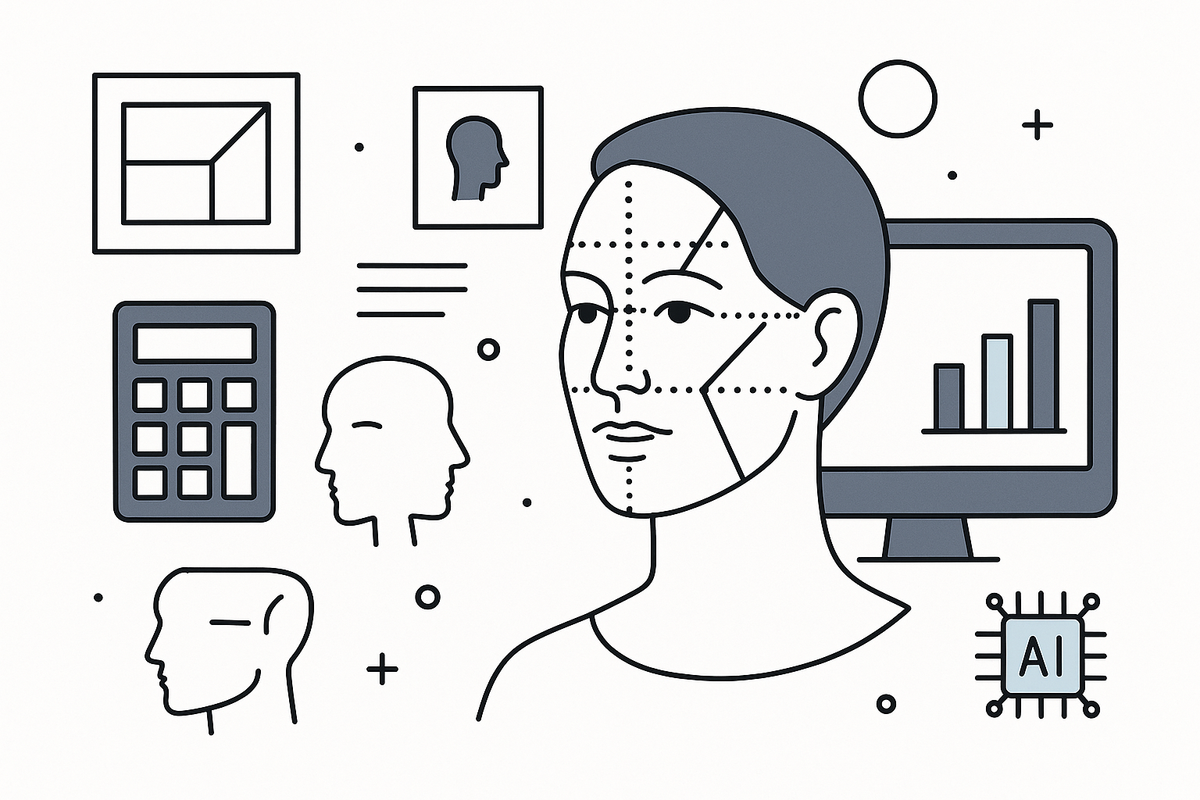
At the core of any face ratio calculator is facial landmark detection. Using deep learning models trained on thousands of annotated faces, the software automatically detects specific points on your face, such as the corners of your eyes, tip of the nose, and edges of the lips. This process works even with minor variations in lighting, expression, or head angle (as long as the photo meets minimum quality standards).
- Typically identifies 68 to over 100 key points on the face
- Points are mapped to a 2D coordinate grid for precise measurement
- AI adjusts for scale and rotation to standardize different images
Measuring Facial Ratios
Once landmarks are detected, the calculator measures distances and proportions between these points. Examples include:
- Width between the eyes
- Length of the nose
- Distance between chin and forehead
- Width of the mouth relative to nose
Automating the Process
The entire analysis is automated. After uploading your photo, the AI handles detection, measurement, and calculation. The results are displayed with overlays, annotated lines, and numeric scores—making complex math accessible to anyone. This streamlined automation is what sets modern calculators apart from old-school manual measurement tools.
Section 3: Facial Landmarks and Ratios Measured
Key Facial Landmarks Used
A robust face ratio calculator will analyze dozens of facial landmarks, with the most important including:
- Pupils and eye corners
- Eyebrow peaks and ends
- Nasal tip and nostril edges
- Cheekbone high points
- Mouth edges and Cupid's bow
- Jawline angles and chin tip
- Forehead hairline (if visible)
Commonly Measured Ratios
The analysis focuses on ratios believed to reflect facial attractiveness and harmony. These include:
- Facial width-to-length ratio: The ratio of the width of the cheekbones to the length from the hairline to the chin.
- Eye spacing: The distance between the inner eye corners compared to the width of the eyes themselves.
- Facial thirds: The face is divided horizontally into three equal sections: hairline to brow, brow to base of nose, and nose to chin.
- Nose width-to-mouth width: The ratio between the width of the nose and the mouth.
- Jawline symmetry: Comparing left and right jaw angles.
- Other golden ratio benchmarks: Such as the 1:1.618 ratio between various facial distances.
Feature-by-Feature Results
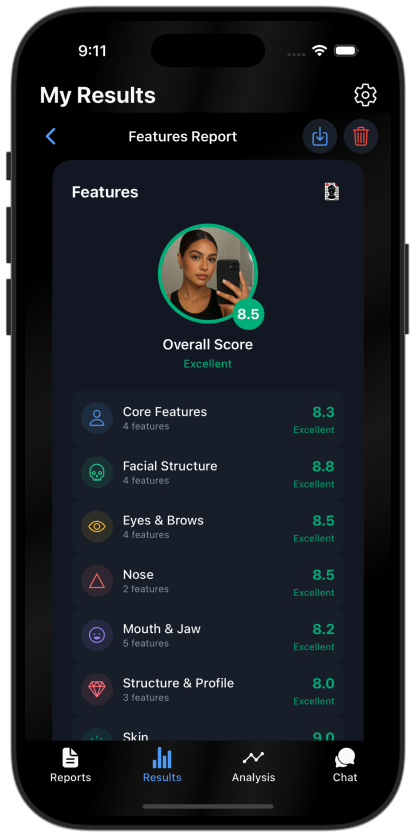
Most face ratio calculators, including Maxx Report, provide a detailed feature breakdown. You may see specific scores for jawline, cheekbones, nose, lips, eye area, and overall facial symmetry. This helps users understand which areas align with classical harmony and which may be less proportional.
Section 4: Scoring Methods—Golden Ratio and Harmony
The Golden Ratio (Phi, 1.618)
The "golden ratio" (1.618, also known as phi) has long been associated with beauty and natural harmony. In facial analysis, the golden ratio is used as a benchmark for ideal proportions. For example, the length of the face divided by its width, or the width of the mouth relative to the width of the nose, is compared to 1.618.
- If your ratio is close to 1.618, it's considered more "harmonious" or "aesthetically pleasing".
- Deviations from this ratio are scored as less ideal, though real-world beauty is much more complex.
To dive deeper into how the golden ratio influences facial analysis, see our in-depth guide: Golden Ratio Face: The Science of Perfect Facial Proportions.
Harmony Score and Pass/Fail Metrics
Most calculators present a "harmony score," summarizing how closely your facial ratios match the golden ratio. This is often displayed as:
- A percentage (e.g., 87% harmony)
- A pass/fail for each feature (e.g., "jawline: pass, nose: close, eyes: needs improvement")
- Color-coded overlays (green = close to ideal, yellow = moderate, red = far from ideal)
Scores are calculated using mathematical formulas comparing your measured ratios to target benchmarks. Some calculators also provide percentile comparisons to population averages.
Breakdown of Results
High-quality calculators will give you a full report, not just a single score. Expect to see:
- Numeric values for each measured ratio
- Annotated images showing measurement lines and points
- Detailed explanations for each feature's score
Section 5: Step-by-Step Guide to Using a Face Ratio Calculator
Step 1: Preparing Your Photo
For the most accurate results, start with a high-quality, front-facing image. Follow these tips:
- Use neutral, even lighting (avoid shadows on your face)
- Look straight at the camera, with your face centered in the frame
- Keep a neutral expression—no exaggerated smiles or frowns
- Remove glasses or other items that could obscure landmarks
- Hair should be away from the face if possible, especially the forehead
Step 2: Uploading and Detecting Landmarks
Upload your prepared photo to the calculator (browser-based or app). The AI will automatically scan the image and highlight detected landmarks, such as eye corners, nose tip, and jawline. Some tools let you adjust points manually if detection is slightly off.
Step 3: Reviewing Ratios and Results
After processing, you'll receive a detailed breakdown of your facial ratios, side-by-side with ideal values. Look for:
- Annotated images with overlay lines and measurement markers
- Numeric ratio values and their closeness to the golden ratio
- Feature-based scores and an overall harmony score
Some calculators, like those in Maxx Report, also offer personalized transformation plans based on your unique facial structure.
Step 4: Interpreting and Using Your Results
Use the feedback to guide personal grooming, styling, or even digital makeovers. For advanced tips on using your face analysis for a glow-up, check out AI Glow Up Tips That Work.
Section 6: Types, Limits, and Accuracy of Face Ratio Calculators
Browser-Based AI Tools vs. Manual Calculators
There are two main types of face ratio calculators:
- AI-powered browser/app tools: Upload a photo, and the system automatically detects landmarks and measures ratios. Fast, accessible, and consistent.
- Manual measurement calculators: Users upload a photo, mark landmarks themselves, and measure distances with built-in rulers. More control, but slower and prone to human error.
AI-based tools are rapidly becoming the standard for both accuracy and user experience.
Limits of 2D Photo Analysis
While face ratio calculators offer valuable insights, they are not clinical anthropometric tools. Their limitations include:
- Analysis is based on 2D images—not 3D scans—so depth is not measured.
- Lighting, camera angle, and facial expression can affect landmark accuracy.
- Not a substitute for professional diagnosis or surgical planning.
For a more nuanced understanding of face shapes, you might also explore our Face Shape Quiz with AI Analysis.
How Accurate Are Face Ratio Calculators?
Accuracy can be very high with quality photos and advanced AI, often within a few millimeters for landmark detection. Still, results are best seen as estimates—useful for personal insight and fun, not for medical or life-changing decisions.
Section 7: Why Results Differ Between Calculators
Landmark Count and Placement
Different calculators use different numbers and placements of facial landmarks. Some measure as few as 14 points, while advanced AI tools may analyze 68, 81, or even over 100 points. More landmarks generally mean more detailed and nuanced results.
Variety in Ratio Formulas
Not all calculators use the same formulas. For example:
- Some focus heavily on golden ratio measurements
- Others include additional anthropometric ratios, such as midface proportions or canthal tilt
- Benchmarks may be based on different population data
Differences in Output and Scoring
Some calculators provide only a simple pass/fail or single score, while others (like Maxx Report) deliver a comprehensive breakdown with annotated overlays, percentile comparisons, and actionable insights. The algorithms and target ideals (e.g., golden ratio vs. population average) also influence the final results.
Section 8: Understanding and Interpreting Your Results
Visible Output and Overlays
The most useful calculators present results visually, using overlays on your uploaded photo. Expect to see:
- Lines marking measured distances (e.g., eye-to-eye, nose width, face length)
- Highlighted landmarks for each facial feature
- Color-coded segments indicating how close you are to targets
Score Reports and Feature Analysis
A comprehensive report will give you:
- Numeric harmony or golden ratio scores for each facial area
- Overall facial symmetry rating
- Actionable suggestions for improvement (e.g., grooming, hairstyles)
For example, Maxx Report not only provides you with a harmony score, but also offers a personalized transformation plan, making your results actionable for real-world looksmaxxing.
What to Do With Your Analysis
Use your results as a guide—not a verdict. Facial harmony is just one aspect of beauty, and everyone has unique strengths. Leverage the insights to enhance your grooming, try new makeup, or explore digital makeovers (see our article on AI-powered digital makeovers for ideas).
Conclusion
A face ratio calculator—especially those powered by AI—is a powerful tool for understanding your facial proportions and symmetry. By detecting landmarks, measuring key ratios, and comparing them to the golden ratio or other benchmarks, these tools offer detailed, actionable insights into your facial structure. Whether you're seeking a fun self-assessment or pursuing a targeted looksmaxxing journey, modern calculators like Maxx Report make facial analysis simple, accessible, and personalized. Remember to use high-quality photos, interpret results as guidance (not gospel), and embrace your unique features as part of your personal style evolution.
FAQ
Q: How does a face ratio calculator work?
A face ratio calculator uses AI to detect specific facial landmarks on your photo, measures the distances between them, and calculates ratios. These ratios are then compared to ideal benchmarks like the golden ratio, providing a score for overall harmony and feature-by-feature analysis.
Q: What facial ratios does a golden ratio face calculator measure?
Common ratios include face length-to-width, eye spacing, facial thirds (forehead to brow, brow to nose, nose to chin), nose width-to-mouth width, and jawline symmetry. Each is compared to the golden ratio (1.618) or other harmony standards.
Q: How accurate is a face ratio calculator from a photo?
With a high-quality, front-facing photo and advanced AI, accuracy can be within a few millimeters for landmark detection. However, it's still an estimate, not a clinical 3D scan or anthropometric exam.
Q: What is the golden ratio in facial analysis?
The golden ratio (approximately 1.618) is a mathematical proportion often associated with beauty and harmony. In facial analysis, it's used as a benchmark: the closer your facial ratios are to 1.618, the more "ideal" they're considered.
Q: What photo should I upload for the best face ratio calculator results?
Use a clear, well-lit, front-facing photo with your face centered and a neutral expression. Remove glasses or obstructions, and keep hair away from the face if possible.
Q: Is a face ratio calculator the same as a face shape calculator?
No. A face ratio calculator measures specific proportions and symmetry, while a face shape calculator categorizes your face into types (oval, round, square, etc.) based on overall outline. Some tools, like Maxx Report, can do both.