
Face Symmetry AI: Meaning, Analysis, and How It Works
Discover what face symmetry AI tests measure, how scores are calculated, and how to take photos for accurate analysis of your facial symmetry and attractiveness.


Estimated reading time: 14 min
Key Takeaways
- Face symmetry AI measures the balance and alignment of facial features using facial landmark detection and geometric analysis.
- Accurate photos with neutral expressions, even lighting, and minimal obstructions are important for reliable face symmetry analysis.
- Symmetry scores evaluate eyes, nose, lips, jawline, cheekbones, and midline alignment, often translating these into attractiveness ratings and personalized recommendations.
- Facial symmetry is one factor in perceived beauty and is complemented by proportion metrics like the golden ratio and skin quality assessments.
- AI face symmetry tools have applications beyond aesthetics, including medical facial palsy assessment, psychological research, and cosmetic enhancement planning.
Table of Contents
- Section 1: Understanding Face Symmetry AI and Its Measurements
- Section 2: How to Take the Best Photo for Face Symmetry AI Analysis
- Section 3: Facial Features Evaluated by AI Symmetry Tests
- Section 4: Interpreting Face Symmetry Scores and Rating Bands
- Section 5: The Role of Facial Symmetry in Attractiveness and Beauty Standards
- Section 6: Golden Ratio Versus Facial Symmetry: What Matters More?
- Section 7: Privacy, Data Handling, and Technical Methods Behind AI Symmetry Analysis
- Section 8: Beyond Beauty: Medical, Research, and Enhancement Uses of Face Symmetry AI
- Conclusion
- FAQ
Section 1: Understanding Face Symmetry AI and Its Measurements
What Does Face Symmetry AI Measure?
Face symmetry AI assesses how closely the left and right halves of a face mirror each other by analyzing the spatial relationships and alignment of key facial landmarks. These landmarks include points such as the inner and outer corners of the eyes, the tip and sides of the nose, corners of the lips, jawline points, and cheekbone prominences. The AI maps these points to create a detailed facial topology that serves as the basis for symmetry analysis.
For example, the AI may measure the horizontal distance between the eyes on both sides, the vertical alignment of the nostrils relative to the midline, or the relative height of the eyebrows. This mapping allows the AI to detect asymmetries, including subtle ones that may be difficult to perceive visually, such as a slight deviation of the chin from the face's vertical axis or a minor difference in cheekbone height.
How Is the Symmetry Score Calculated?
After landmark detection, the AI calculates symmetry scores through a multi-step geometric and statistical process:
- Midline alignment assessment: A vertical midline is established by connecting central facial features such as the glabella (between the eyebrows), nose tip, and chin. The AI evaluates how well features on each side align with this midline, considering lateral deviations. For instance, if the nose tip deviates 3 mm to one side, this impacts the midline deviation metric.
- Distance and angle differences: The AI calculates paired distances between symmetric landmarks — like the distance from each eye corner to the nose tip. It then compares these distances for disparity. Similarly, it measures angles formed by features such as the jawline or eyebrow arch on each side, quantifying angular asymmetries.
- Proportional balance: The system analyzes size ratios of features on each side — for example, comparing the width of the left cheekbone to the right. It normalizes these ratios relative to overall face size to avoid bias from face scale or photo zoom.
These individual metrics are normalized to a common scale and combined using weighted algorithms that prioritize features known to impact perceived symmetry more heavily, such as the eyes and midface. The final composite symmetry score typically ranges from 0 to 100%, with higher values indicating closer bilateral symmetry.
AI Techniques Behind the Measurement
Face symmetry AI leverages a combination of computer vision and machine learning techniques:
- Facial landmark detection: Convolutional neural networks (CNNs), trained on diverse datasets comprising annotated faces, detect over 68 to 100 key facial landmarks. These networks can handle variations in ethnicity, age, and lighting to accurately locate facial features.
- 3D imaging and depth estimation: Some advanced tools reconstruct a 3D facial mesh from 2D images using photogrammetry or depth sensors. This 3D model allows analysis of symmetry in all dimensions, capturing asymmetries not visible in flat images, such as subtle protrusions or recessions of facial contours.
- Machine learning models: Beyond raw geometric calculations, AI models trained on labeled datasets of symmetric and asymmetric faces learn to weight features according to their aesthetic impact. These models can refine scoring algorithms by incorporating perceptual factors and human attractiveness ratings.
- Statistical shape analysis: Algorithms such as Procrustes analysis align faces to a common coordinate system to facilitate comparison of shape variations, enabling quantification of asymmetry independent of pose variations.
Collectively, these methods enable automated facial symmetry assessments that can offer detailed analysis beyond traditional manual measurements.
Section 2: How to Take the Best Photo for Face Symmetry AI Analysis
Lighting and Background
Optimal lighting and background conditions help ensure the AI can accurately detect facial landmarks without interference from shadows or background distractions. Here are tips with technical rationale:
- Use soft, even lighting: Employ diffused frontal lighting — such as natural daylight near a window or a ring light — to minimize harsh shadows that can occlude features or create misleading contours. Avoid direct flash or spotlighting which can cause glare or uneven illumination.
- Neutral background: Select a plain, matte background with a solid color (e.g., white, grey, or beige) to prevent the AI from misidentifying background patterns as facial features. Avoid cluttered or textured backgrounds.
- Avoid mixed or colored lighting: Ensure all light sources have consistent color temperature to prevent color casts that can confuse landmark detection algorithms.
- Control reflections and glare: Remove glasses or jewelry that produce reflections, which can distort feature detection.
Facial Positioning and Expression
Precise facial positioning helps ensure that the AI analyzes the face in a standardized orientation:
- Face the camera straight-on: Align your face parallel to the camera sensor, avoiding tilting, turning, or leaning. A head position with less than 5 degrees deviation in yaw (left-right turn) or pitch (up-down tilt) is ideal.
- Neutral expression: Maintain a relaxed, closed-mouth expression. Smiling or frowning alters muscle tension and shape, particularly around the mouth and eyes, which can affect symmetry measures.
- Hair management: Pull hair back or tuck it behind ears to expose the entire face, including temples and jawline. Hair covering portions of the face can confuse landmark detection.
- Remove accessories: Avoid hats, scarves, or large earrings that may obstruct facial features.
Camera Setup and Resolution
Technical camera settings improve photo quality and analysis reliability:
- High-resolution capture: Use a camera or smartphone capable of at least 8 megapixels to capture fine feature details. Higher resolution reduces pixelation and improves landmark detection accuracy.
- Camera at eye level: Position the camera lens at the same vertical height as your eyes to prevent perspective distortion that elongates or compresses facial features.
- Distance and framing: Maintain a distance of approximately 1 to 2 meters (3 to 6 feet) to capture the full face and neck without excessive zooming or cropping. Ensure the entire face fits within the frame with minimal background.
- Stable camera: Use a tripod or stable surface to prevent motion blur, especially in lower light conditions.
- Use manual focus if available: Ensure the camera focuses precisely on the face rather than the background.
Following these guidelines helps AI tools like Maxx Report deliver precise face symmetry analysis and reliable ratings that reflect your natural features.
Section 3: Facial Features Evaluated by AI Symmetry Tests
Eyes and Eyebrows
The eyes and eyebrows are among the most expressive and symmetry-sensitive facial features. The AI evaluates:
- Interocular distance: The horizontal distance between inner and outer eye corners on each side, ideally symmetric and proportional to face width.
- Eye shape and size: Comparison of eye widths, heights, and contour shapes, including eyelid symmetry (e.g., upper lid fold height, lower lid curvature).
- Eyelid height and openness: Detecting differences in how open each eye appears, which can indicate asymmetry or ptosis.
- Eyebrow arch and position: Measuring the height and curvature of each eyebrow, as well as alignment relative to the eyes and forehead.
For example, if the right eyebrow arches 5 mm higher than the left, or if one eye is 2 mm wider, these affect the symmetry score. Such asymmetries can alter expressions perceived by others and impact attractiveness ratings.
Nose and Midline Alignment
The nose acts as the central anchor of the face. The AI evaluates:
- Nose shape and width: Comparing the width of the nostrils and bridge on each side.
- Deviation from vertical midline: Measuring lateral displacement or tilt of the nose tip or bridge from the central axis.
- Nasal base symmetry: Assessing the alignment of the nostrils and nasal wings.
- Nasal length and proportion: Relative size compared to other facial features.
Even slight deviations, such as a 3 mm shift of the nose tip to the left or a tilted nasal bridge, reduce symmetry scores. The AI quantifies these to reflect how nose asymmetry affects overall facial harmony.
Lips and Mouth
The mouth's shape and position impact expressions and perceived attractiveness. The AI measures:
- Lip fullness and volume: Comparing thickness of upper and lower lips on each side.
- Lip corner height: Assessing if one corner of the mouth sits higher, indicating asymmetry or habitual expressions.
- Shape and curvature: Evaluating the contour of the lips, especially the cupid’s bow and vermilion border, for bilateral symmetry.
- Smile symmetry (if applicable): For photos with expression, but neutral is preferred for accuracy.
For instance, a lip corner that is 4 mm higher on one side or uneven fullness affects symmetry scores and may influence smile aesthetics.
Jawline and Chin
The jawline and chin define the lower face's shape and balance. The AI analyzes:
- Jaw angle and contour: Comparing the angle and curvature of each side’s jawline for evenness.
- Chin position: Measuring lateral displacement from the midline and vertical height.
- Chin width and shape: Assessing proportionality between sides.
Asymmetries such as a shifted chin by 3-5 mm or uneven jaw angles can affect perceived facial harmony, impacting the symmetry score.
Cheekbones and Facial Contours
Cheekbones contribute significantly to facial structure and are key to attractiveness. The AI evaluates:
- Cheekbone height and prominence: Comparing vertical position and projection on each side.
- Facial contour curves: Analyzing smoothness and symmetry of the cheeks and midface curvature.
- Soft tissue volume: Indirectly inferring fullness and symmetry in fat distribution.
Symmetric cheekbones create balanced shadows and highlights that enhance aesthetic appeal. Differences in height or projection greater than a few millimeters can reduce symmetry scores and affect glow-up recommendations.
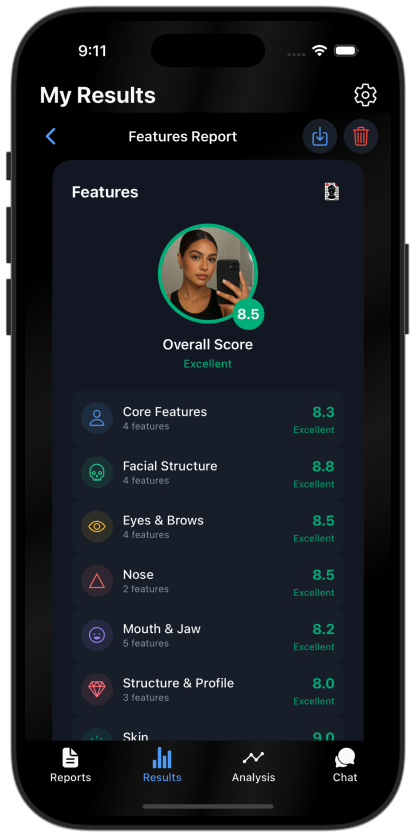
Section 4: Interpreting Face Symmetry Scores and Rating Bands
Understanding Symmetry Score Ranges
Symmetry AI tools output a numeric score or percentage, often on a 0–100 scale. These scores should be interpreted within context:
- High symmetry (80-100%): Faces in this range exhibit near-bilateral balance. Such symmetry is less common and often aligns with faces rated highly attractive in some psychological studies. For instance, a score of 90% may correspond to minimal measurable asymmetries under 1-2 mm across features.
- Moderate symmetry (60-79%): This range represents typical human variation, with mild asymmetries that are common and generally not noticeable to casual observers. A score of 70% might reflect minor deviations like a slightly higher eyebrow or uneven lip fullness.
- Low symmetry (below 60%): More noticeable asymmetries are present, potentially impacting perceived attractiveness. Scores below 50% may indicate larger midline shifts, uneven jawlines, or pronounced feature size discrepancies and might warrant medical evaluation if caused by underlying conditions.
It is important to note that symmetry is only one aspect of facial attractiveness, and even individuals with asymmetries can be perceived as beautiful due to other factors.
Rating Bands and Descriptions
Many AI platforms provide qualitative rating bands alongside numeric scores to help users understand their results:
- Close match: Symmetry differences are minimal and barely perceptible. Users in this band often have scores above 85%. The face appears naturally balanced with harmonious features.
- Moderate difference: Slight asymmetries visible upon close inspection but generally do not detract from overall facial harmony. Scores typically range from 65-84%. Makeup or hairstyle adjustments can often visually balance these differences.
- Marked difference: Noticeable imbalance in key features such as nose deviation, uneven jawline, or eyebrow height, which can impact aesthetic appeal. Scores below 65% fall here. Individuals may consider cosmetic options or medical consultation depending on cause.
Using Scores for Glow-Up and Transformation Plans
Platforms like Maxx Report integrate symmetry scores with other facial metrics to create personalized recommendations for improving facial harmony:
- Makeup tips: Techniques such as contouring and highlighting can visually correct asymmetries by creating optical illusions. For example, shading a prominent cheekbone on one side or enhancing eyebrows to match heights.
- Hairstyles: Suggestions include styles that frame the face symmetrically or draw attention away from asymmetrical areas, such as side parts, bangs, or volume adjustments.
- Skincare and grooming: Targeted treatments to improve skin texture and brightness can enhance overall facial balance by reducing visual distractions.
- Orthodontic or cosmetic interventions: In cases of significant asymmetry, recommendations may include orthodontics for jaw alignment, rhinoplasty, or non-invasive procedures like fillers.
Tracking symmetry scores over time allows users to monitor progress and effectiveness of interventions.
Section 5: The Role of Facial Symmetry in Attractiveness and Beauty Standards
Why Facial Symmetry Matters
Facial symmetry is often considered a biological marker of genetic health and developmental stability. Symmetric faces may signal good health and strong genes, which could explain their appeal as attractive.
Psychological research indicates that individuals with higher facial symmetry are often perceived as more trustworthy, healthy, and socially dominant. Some studies have shown that when participants rate faces, those with subtle asymmetries tend to receive lower attractiveness scores even when other features are appealing.
Furthermore, symmetry is linked to cognitive fluency — symmetric faces are easier for the brain to process, which may contribute to positive bias in social perception.
Cultural and Evolutionary Perspectives
Cross-cultural studies reveal a consistent preference for symmetric faces across diverse societies, suggesting an evolutionary basis. Symmetry preferences may have evolved as a heuristic for mate selection, favoring individuals with robust genetic makeup and fewer developmental perturbations.
However, perfect symmetry is exceedingly rare in nature; most faces exhibit some degree of asymmetry, which can contribute to uniqueness and character. Cultural beauty standards also integrate other factors such as skin tone, feature size, and expression, meaning symmetry is one component among many.
For example, in some cultures, slight asymmetries or distinct facial marks are considered signs of beauty or individuality. Thus, AI symmetry scores should be viewed as part of a broader aesthetic context.
Symmetry Versus Other Beauty Factors
While symmetry plays a significant role, it is complemented by other factors:
- Skin quality: Clear, smooth skin often influences attractiveness more immediately than symmetry.
- Facial proportions: Balanced ratios between features (see Section 6 on golden ratio).
- Facial expression: Warm, genuine expressions can enhance perceived beauty regardless of symmetry.
- Personality and charisma: Social and emotional traits impact attractiveness beyond physical features.
Advanced AI tools combine these elements to provide comprehensive facial attractiveness assessments rather than relying solely on symmetry.
Section 6: Golden Ratio Versus Facial Symmetry: What Matters More?
Understanding the Golden Ratio in Faces
The golden ratio (~1.618) is a mathematical constant frequently observed in nature, art, and architecture. In facial aesthetics, it relates to ideal proportions between various facial features such as:
- The width of the nose compared to the mouth.
- The distance between the eyes relative to face width.
- The ratio of the length of the face to its width.
- The positioning of the lips relative to the nose and chin.
For example, a nose width that is approximately 1.6 times smaller than the mouth width aligns with golden ratio principles. Classical sculptures and portraits often exhibit these proportions, which are associated with pleasing aesthetics.
Differences Between Proportion and Symmetry
Facial symmetry evaluates the mirroring of features between the left and right halves of the face, focusing on bilateral balance. The golden ratio examines harmonious size and distance relationships between features irrespective of left-right mirroring.
A face can be symmetric but lack ideal proportions, resulting in a less aesthetically balanced appearance. Conversely, a face may have excellent proportions but exhibit asymmetries in feature placement or size.
For instance, a person might have equal eye sizes and levels on both sides (high symmetry) but a nose that is wider than the golden ratio suggests, impacting overall attractiveness.
Which Influences Attractiveness More?
Research suggests both symmetry and golden ratio-based proportions contribute independently to facial attractiveness:
- Symmetry influences immediate perceptions related to health and harmony, affecting how balanced and natural a face looks at first glance.
- Proportion impacts aesthetic balance and the subtle visual harmony between features, often influencing longer-term attractiveness judgments.
Modern AI beauty tools, including Maxx Report, analyze both aspects to provide nuanced assessments. They may score symmetry and proportion separately, then combine them for an overall attractiveness index. This dual approach allows for personalized guidance, for example, suggesting contouring to adjust perceived proportions or recommending orthodontics to improve symmetry.
Learn more about the golden ratio face and how it complements symmetry in comprehensive beauty analysis.
Section 7: Privacy, Data Handling, and Technical Methods Behind AI Symmetry Analysis
Privacy Concerns with Online Face Symmetry Checkers
Uploading facial photos to AI tools raises privacy and data security concerns. Reputable platforms like Maxx Report implement safeguards:
- Secure transmission: Photos are uploaded using encrypted HTTPS protocols to prevent interception.
- Data minimization: Only necessary data and key points are stored temporarily. Raw photos are often deleted immediately after analysis unless users explicitly opt-in for storage or account creation.
- Transparent policies: Clear privacy statements inform users about data usage, retention periods, and third-party sharing.
- Compliance: Adherence to regulations such as GDPR (Europe) and CCPA (California) helps ensure user rights and data protection.
- User control: Options to delete data, revoke consent, or download analysis reports.
Users should review platform policies and prefer services with a track record of responsible data handling.
Technical Methods: Facial Landmark Detection and 3D Modeling
Key technologies enabling accurate face symmetry AI include:
- Facial landmark detection: Algorithms identify 68 or more key points on the face (e.g., eyes, nose, mouth corners, jawline points). These landmarks are the basis for geometric and symmetry computations.
- 3D imaging: Emerging tools utilize depth sensing cameras or photogrammetry techniques to reconstruct 3D facial topology from 2D images, enabling analysis of asymmetries in depth and contour beyond flat planes.
- Deep learning models: Neural networks trained on large, diverse face datasets improve detection accuracy and robustness against variations in pose, lighting, and facial expressions.
- Data augmentation: Training data includes faces with varying ethnicities, ages, genders, and expressions to reduce bias.
- Multi-module integration: Combining symmetry analysis with skin condition assessment, feature rating, and expression recognition to create holistic facial analysis platforms.
Ensuring Accuracy and Consistency
Accuracy depends on multiple factors:
- Diverse training data: Ensures AI models generalize well across populations.
- Photo quality: Consistent photo capture guidelines (Section 2) reduce errors due to shadows, distortions, or occlusions.
- Algorithm updates: Continuous model retraining with new data and user feedback improves performance over time.
- Cross-validation: Comparing AI outputs with expert human assessments and clinical measurements to validate results.
Platforms like Maxx Report employ these approaches to maintain trustworthy, repeatable symmetry analyses.
Section 8: Beyond Beauty: Medical, Research, and Enhancement Uses of Face Symmetry AI
Medical Applications
Facial asymmetry is a feature of various medical conditions including:
- Facial palsy and Bell’s palsy: AI can quantify the extent of muscle weakness or paralysis by measuring asymmetry in eyelid closure, smile, and brow position, assisting in diagnosis and progress monitoring.
- Stroke assessment: Early detection of facial drooping via AI could support rapid stroke identification and treatment.
- Congenital deformities: Conditions like hemifacial microsomia or cleft lip/palate show characteristic asymmetries. AI symmetry metrics provide objective measures for surgical planning and outcome evaluation.
- Orthodontics and maxillofacial surgery: Planning jaw realignments or reconstructive procedures benefit from precise symmetry analysis for optimal functional and aesthetic results.
Quantitative AI assessments can reduce subjectivity and enable longitudinal tracking of treatment effectiveness.
Research in Psychology and Anthropology
AI-powered face symmetry tools facilitate large-scale studies by automating measurements previously done manually:
- Human evolution: Investigating correlations between facial symmetry and genetic fitness across populations.
- Attractiveness cues: Studying how symmetry interacts with other facial features in influencing mate choice and social perception.
- Social psychology: Exploring the role of facial symmetry in trustworthiness and leadership perceptions.
- Anthropometric surveys: Collecting standardized facial measurements across ethnicities and age groups.
These applications advance scientific understanding of human facial diversity and social cognition.
Enhancement and Retouching Tools
AI symmetry data guides a range of enhancement technologies:
- Digital makeup and retouching: Algorithms apply virtual contouring, reshaping, or lighting adjustments to improve facial balance in photos and videos.
- Cosmetic procedure planning: Surgeons and patients can simulate potential outcomes of rhinoplasty, fillers, or orthodontics informed by symmetry analysis.
- Personalized glow-up tips: Tools like Maxx Report’s AI glow up leverage symmetry insights to suggest targeted lifestyle, grooming, and style changes that optimize appearance.
- Augmented reality (AR) filters: Real-time symmetry corrections in social media apps enhance user confidence and engagement.
These applications empower users to enhance and understand their facial aesthetics in an informed, data-driven manner.
Conclusion
Face symmetry AI represents a sophisticated intersection of computer vision, machine learning, and aesthetics, providing objective quantification of one aspect of facial attractiveness. By understanding what these AI tests measure, how to prepare photos for analysis, and how to interpret scores, users can leverage insights for improving beauty, monitoring health, or advancing research.
While facial symmetry plays a key role in perceived beauty, it is most effective when combined with assessments of facial proportions, skin quality, and expression. Platforms like Maxx Report integrate these dimensions to provide personalized, AI-driven face symmetry analysis alongside comprehensive looksmaxxing advice, empowering individuals to transform their appearance confidently, safely, and scientifically.
FAQ
Q: How do AI face symmetry tests work?
A: AI face symmetry tests use facial landmark detection to identify key feature points on both sides of the face. They then calculate differences in distances, angles, and alignment between corresponding features to produce a symmetry score that reflects how balanced the face halves are.
Q: What is a good face symmetry score?
A: Scores above 80% generally indicate high facial symmetry with minimal visible asymmetry and correspond to faces often rated as attractive. Moderate scores between 60-79% reflect common mild asymmetries, while scores below 60% suggest noticeable imbalance that may affect perceived facial harmony.
Q: How accurate are online face symmetry checkers?
A: Accuracy depends on factors like photo quality, AI model sophistication, and landmark detection precision. Reputable tools like Maxx Report employ advanced AI algorithms and require proper photo conditions to deliver reliable results, though no system is perfect.
Q: Does facial symmetry affect attractiveness more than the golden ratio?
A: Both facial symmetry and golden ratio-based proportions influence attractiveness. Symmetry relates to balance between face halves, whereas the golden ratio pertains to proportional relationships between features. Together, they provide a fuller understanding of facial aesthetics.
Q: How can I take a photo for the most accurate face symmetry test?
A: Use evenly diffused frontal lighting, maintain a neutral facial expression, face the camera straight-on at eye level, keep hair away from the face, use a high-resolution camera, and avoid shadows or obstructions for the best results.
Q: Can AI detect facial asymmetry for medical or research purposes?
A: Yes. AI facial symmetry analysis is used in medical diagnostics to detect and monitor conditions like facial palsy and stroke, as well as in psychology and anthropology research to objectively study human facial traits at scale.