
fWHR Meaning: What Facial Width-to-Height Ratio Reveals About You
Discover fWHR meaning, how to measure facial width-to-height ratio, typical ranges, links to dominance, attractiveness, and if you can improve your fWHR.

Estimated reading time: 13 min
Key Takeaways
Free tools for this guide (run in your browser, no sign-up):
- FWHR calculator (facial width-to-height ratio)
- fWHR (Facial Width-to-Height Ratio) is a key facial metric in psychology and aesthetics, defined as the bizygomatic width divided by upper facial height.
- Measuring fWHR involves precise points on the face, and small errors or different methods can change results.
- Higher fWHR has been linked to perceived dominance, masculinity, and aggression, but research findings are mixed.
- fWHR is not set in stone; while bone structure is stable, appearance can shift with weight, posture, or camera angle.
- Apps like Maxx Report use AI to analyze your fWHR and related facial features for personalized glow-up plans.
Table of Contents
- Section 1: fWHR Meaning and Definition
- Section 2: The Formula and Variants of fWHR
- Section 3: How to Measure Your fWHR (Step-by-Step)
- Section 4: Typical fWHR Ranges and What They Indicate
- Section 5: fWHR in Research—Dominance, Attractiveness, and More
- Section 6: Limitations, Confounds, and the Truth About Changing fWHR
- Conclusion
- FAQ
Section 1: fWHR Meaning and Definition
What Does fWHR Stand For?
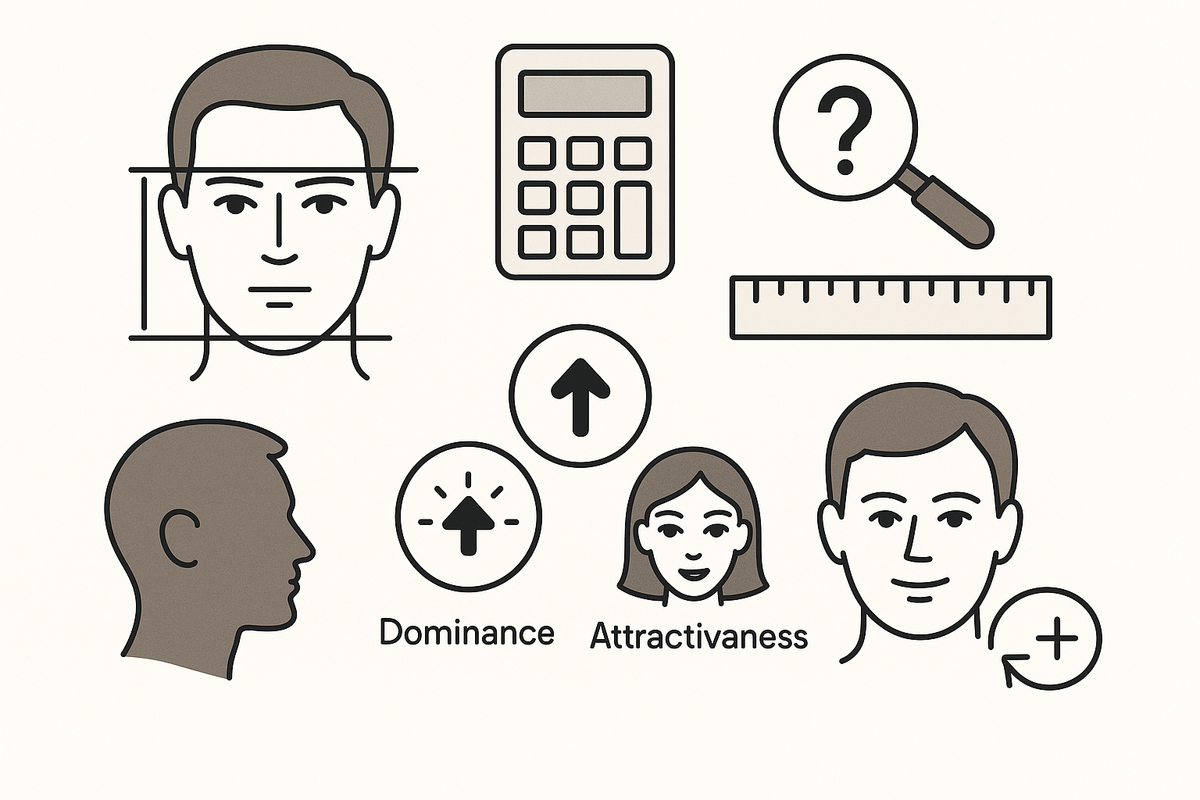
fWHR stands for Facial Width-to-Height Ratio. In simple terms, it describes how wide your face is compared to its height in a specific region. This measurement has become a popular metric in both psychological research and the world of facial aesthetics.
Why Is fWHR Important?
Researchers and looksmaxxing enthusiasts pay close attention to fWHR, as it’s thought to signal various traits such as dominance, aggression, masculinity, and even attractiveness. It’s a quick, objective way to compare facial proportions across individuals or populations.
Beyond research, fWHR has found a place in popular culture. You may have seen discussions of "wide faces" and "masculine ratios" on forums, in dating advice columns, or even in entertainment media. The simplicity of the measurement—just two numbers—makes it an accessible way to discuss complex topics like facial structure and first impressions.
Origins and Use in Science
- First popularized in evolutionary psychology and behavioral studies. Early studies sought to connect facial structure with behavioral tendencies, theorizing that broader faces might signal more aggressive or dominant behavior in evolutionary contexts.
- Frequently measured in both human and primate research. Comparative studies have examined fWHR in chimpanzees, bonobos, and other primates, looking for evolutionary patterns and social cues that may be shared across species.
- Now widely used in AI-based facial analysis tools, such as Maxx Report, to assess your face’s proportions automatically. This has enabled large-scale, population-level analyses that were previously impractical.
Understanding fWHR meaning gives you a foundation for interpreting facial analysis results and what they could imply about personality, perceived strength, or even first impressions. For example, a high fWHR might be read as a clue to assertiveness, while a lower fWHR might suggest approachability. However, these associations are only tendencies, not rules.
In summary, fWHR has become a bridge between hard science (anthropometry, biology) and the softer sciences (psychology, sociology), as well as practical applications in dating, social media, and personal development.
Section 2: The Formula and Variants of fWHR
The Basic fWHR Formula
At its core, fWHR is calculated as:
- Facial Width (Bizygomatic width): The horizontal distance between the left and right zygion (the widest part of the cheeks, at the cheekbones). This is typically the most protruding point, just below and slightly in front of the ears, and is a standard anthropometric landmark.
- Upper Facial Height: The vertical distance from the highest point of the upper lip (usually the vermilion border) to the highest point of the eyelids (typically the midpoint between the eyebrows). Some studies use the midpoint of the eyebrows instead of the eyelid, which can lead to slightly different results.
The formula: fWHR = Bizygomatic width / Upper facial height
Common Variants and Their Impact
- Some studies use the distance from the highest point of the upper lip to the midpoint of the eyebrows instead of the eyelids. This subtle change can alter the result by several hundredths or tenths, which is significant in research terms.
- Other variants measure height from the upper lip to the bottom of the brow arch, or even from the lip to the highest point of the eyelid crease. This reflects anatomical differences and research preferences, but can lead to confusion when comparing studies.
- Photographic angle and head tilt can significantly alter measurements. Even a slight tilt of a few degrees can make the face appear longer or shorter, changing the calculated ratio. This is why standardized photography is critical in research and personal assessment.
It’s crucial to standardize your method for comparison, as small differences can lead to inconsistencies in results. For example, if you compare your fWHR to published averages, make sure the measurement method matches. Otherwise, you could over- or under-estimate your standing relative to the population.
Automated vs. Manual Measurement
Manual measurement (using calipers or software) requires precise point selection. Even small errors—just a few pixels on a digital image—can shift the fWHR by 0.01 or more, which matters since most population differences are on the order of 0.1. Automated tools like Maxx Report utilize AI to identify facial landmarks, helping reduce human error and standardize the process across thousands of users. These tools not only speed up the process, but also allow for batch analysis and reproducibility—valuable in both personal tracking and academic research.
Furthermore, AI-based systems can adjust for slight head tilt, lighting, and other variables, providing more reliable results than manual measurement, especially for those without training in facial anthropology.
Section 3: How to Measure Your fWHR (Step-by-Step)
Step 1: Take a Proper Photo
- Use a well-lit, high-resolution frontal photo. Natural light is best, as harsh shadows or uneven lighting can distort facial features and make landmark identification difficult.
- Keep your head level, eyes facing directly at the camera, mouth closed, and neutral expression. Smiling or frowning can alter the shape of your cheeks and lips, leading to inaccurate measurements.
- Avoid tilting your head or using wide-angle lenses, which can distort facial proportions. Ideally, use a standard lens (50mm equivalent), position the camera at eye level, and keep your face parallel to the camera sensor.
If possible, use a tripod or a friend to ensure your head is perfectly straight. Consistency is key if you want to track changes over time or compare yourself to population averages.
Step 2: Identify Landmarks
- Zygion points: Locate the widest part of each cheekbone. In most people, this is just below the outer corner of the eye. You may be able to feel these points by running your fingers along your cheekbones.
- Upper Lip: Identify the highest point of the upper vermilion border (where the pink of the lip meets the skin). This point should be directly under the nose, at the center of the mouth when relaxed.
- Mid-Brow or Eyelid: Depending on the variant, mark either the midpoint of the eyebrows or the highest point of the eyelids. If using eyebrows, find the thickest, most central point; if eyelids, use the crease or the uppermost point of the visible lid.
For more accuracy, some people use multiple points and take the average height, especially if their features are asymmetric. Apps like Maxx Report use facial landmark detection algorithms to find these points consistently across different faces and lighting conditions.
Step 3: Measure and Calculate
- Use a ruler (on-screen) or photo-editing software to measure the pixel distance between the zygions (width), and between brow/eyelid and upper lip (height). Many free tools (like GIMP, Photoshop, or even smartphone apps) can provide pixel measurements.
- Divide the width by the height to get your fWHR. Record both values for reference, as some guides and studies may use raw measurements for further analysis.
Example Calculation: If your bizygomatic width is 140 pixels, and your upper facial height is 60 pixels, your fWHR = 140/60 = 2.33.
Advanced Example: Suppose you use a photo with a bizygomatic width of 140 mm and an upper facial height of 70 mm. The fWHR would be 140/70 = 2.0. If you retake the photo with your head slightly tilted, the width appears as 145 mm and the height as 68 mm, so fWHR = 145/68 ≈ 2.13. This demonstrates why consistent technique is essential.
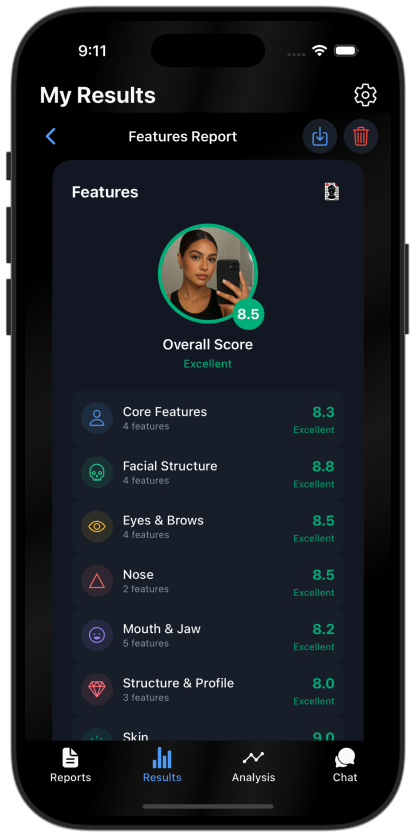
For higher accuracy and convenience, AI beauty apps like Maxx Report automate this process, instantly analyzing your fWHR and other crucial features from a single selfie. These apps provide not only your fWHR but also contextualize your result with percentile rankings, comparisons to population averages, and actionable tips for improvement or enhancement.
Section 4: Typical fWHR Ranges and What They Indicate
What Is a Normal or Average fWHR?
Research on various populations shows that the average fWHR for adult men is typically between 1.8 and 2.1. For women, the average is slightly lower, often ranging from 1.7 to 1.95. There is natural variation due to ethnicity, age, and measurement method.
- Low fWHR: Below 1.7 (narrower faces relative to height)
- Average fWHR: 1.7–2.0 (most people fall here)
- High fWHR: Above 2.0 (wider faces relative to height)
For example, in a large North American sample, roughly 60–70% of males had fWHRs between 1.8 and 2.1, with only 10–15% above 2.1 or below 1.8. Female distributions are similar, but shifted slightly lower.
What Does a High or Low fWHR Suggest?
- High fWHR has been associated in some studies with increased perceptions of dominance, assertiveness, and even aggression. In social settings like negotiations or sports, individuals with high fWHR may be rated as more formidable or competitive.
- Low fWHR is perceived as softer or more gracile, sometimes linked to trustworthiness or approachability. In some contexts, such as customer service or caregiving professions, this may even be an advantage.
It’s important to note that these are population-level trends and not deterministic for individuals. A high-fWHR person may be gentle and introverted, while a low-fWHR face may belong to a fierce competitor. Social context, personality, and other features matter greatly.
Population and Gender Differences
Men, on average, have slightly higher fWHRs than women, contributing to masculine facial cues. However, the difference is modest, and substantial overlap exists. For example, some women have fWHRs above the male average, and vice versa. This overlap means fWHR is only a weak cue of sex or masculinity, especially when considered alone.
Ethnic variation also exists. For instance, studies have found that East Asian populations tend to have slightly higher average fWHRs, while some African and European populations show lower averages. These differences are thought to reflect both genetic and environmental factors, including nutrition and developmental conditions.
If you’re curious how your fWHR compares to your peers, AI-based apps or research tables can give you percentile rankings, similar to face shape quizzes that analyze overall proportions. For example, Maxx Report might show that your fWHR is in the 60th percentile compared to men your age, or that your ratio is typical for your ethnicity and gender.
Additionally, fWHR may change slightly with age. Younger adults tend to have higher facial fat, which can make faces look wider and reduce measured height, increasing fWHR slightly. As people age and lose facial fat or skin elasticity, the ratio may shift downward. This is another reason why age-matched comparisons are most meaningful.
Section 5: fWHR in Research—Dominance, Attractiveness, and More
Links to Dominance and Aggression
fWHR attracted attention after studies suggested men with higher ratios were perceived as more dominant or aggressive. Some research reported correlations between fWHR and aggression in sports, business, and even criminal records. For example, one study found that hockey players with higher fWHR had more penalty minutes.
- Perceived dominance: Higher fWHR faces are often rated as more intimidating or assertive. In mock hiring or negotiation experiments, participants sometimes select higher-fWHR faces for leadership or competitive roles, suggesting a bias toward associating facial width with authority.
- Real-world behavior: Some links found in competitive, high-stakes environments, but not universal. For instance, while some studies find higher fWHR among CEOs of aggressive companies, others find no effect in less combative industries.
- Replication issues: Later studies showed smaller or no effects, suggesting the relationship is not straightforward. Meta-analyses indicate that effect sizes are often small and moderated by context, such as the type of behavior measured or the cultural background of observers.
For example, a 2017 meta-analysis found that the link between fWHR and aggression is present, but weaker than originally reported, and often disappears when controlling for body size or other variables. This suggests that while fWHR may be a cue, it is far from deterministic.
Masculinity and Sex Differences
Because testosterone influences facial bone growth in puberty, fWHR can be a subtle cue of masculinity. However, the effect size is small, and fWHR is just one of many masculine facial features (jaw width, brow ridge, etc).
Studies comparing men and women generally find an average difference in fWHR of about 0.05–0.1, which is less than the difference for jaw width or chin projection. In some subpopulations, such as athletes or bodybuilders, the difference may be larger, but there is still substantial overlap.
Importantly, fWHR is only one aspect of perceived masculinity. Broader jaws, prominent brow ridges, and deep-set eyes are often considered more strongly "masculine" than fWHR alone. For this reason, apps like Maxx Report assess a suite of features when rating masculinity.
Attractiveness: Mixed Evidence
- Some studies suggest women rate slightly higher fWHR as more attractive in short-term contexts or when seeking dominance cues. For instance, in speed dating or short-term attraction scenarios, women may prefer faces with higher fWHR, possibly as a signal of genetic fitness or competitive ability.
- Other research finds no link, or even a negative one in certain cultures, suggesting context matters. In some East Asian populations, for example, lower-fWHR faces are rated as more attractive, possibly due to different cultural ideals of beauty and trustworthiness.
- Overall, fWHR is less consistently linked to attractiveness than features like symmetry or the golden ratio. Most attractiveness studies find that symmetry, skin clarity, and averageness are more powerful predictors of facial appeal than fWHR.
Apps like Maxx Report analyze fWHR alongside other facial features for a holistic attractiveness score, rather than relying on fWHR alone. This is important, as focusing on a single metric can lead to misleading conclusions about one’s overall facial attractiveness or social perception.
In summary, while fWHR has some association with perceived dominance and, in some contexts, attractiveness, its effects are modest and highly context-dependent. It is best viewed as one piece in the larger puzzle of facial analysis.
Section 6: Limitations, Confounds, and the Truth About Changing fWHR
Methodological Limitations
- Measurement errors: Small changes in landmark selection, head tilt, or camera distance can shift fWHR values. For example, a 2-degree tilt can increase or decrease measured height by 1–2mm, leading to changes of 0.02 or more in the ratio.
- Variant confusion: Studies use slightly different methods, making direct comparison tricky. Some measure from lip to brow, others to eyelid, and still others use 3D scans rather than photos. If you’re comparing your fWHR to published studies, always check the method used.
- Sample bias: Many studies use specific populations (college students, athletes), which may not generalize. This can lead to over- or underestimating the importance or prevalence of high fWHR in the broader population.
Additionally, some studies do not control for overall body size or BMI, which can confound results. Larger individuals often have wider faces, so differences attributed to fWHR may actually reflect general body size.
Is fWHR Set for Life?
Since fWHR is determined by your facial bone structure, it remains relatively stable after puberty. However, certain factors can influence your apparent fWHR:
- Weight loss/gain: Facial fat can make your face appear wider or narrower. For example, gaining 10–15 pounds may increase facial width by several millimeters, raising fWHR by 0.02–0.05. Conversely, losing fat can reveal more bone structure, making the face appear longer and reducing fWHR.
- Posture and camera angle: Tilting your head up or down, or using different lenses, can exaggerate or minimize width/height ratios in photos. A selfie taken from above often elongates the face, reducing fWHR, while photos from below can do the opposite.
- Aging: Changes in skin elasticity and muscle tone can subtly affect perceived proportions. As cheeks lose volume and skin sags, measured width may decrease, or the height may increase, slightly lowering fWHR after age 50.
Bone-altering surgery is the only way to permanently change fWHR, but this is rare and extreme. For most, "improving" fWHR means maximizing appearance with grooming, fat loss, or camera technique. Strategic beard grooming, for example, can create the illusion of a wider or narrower face, subtly shifting perceived fWHR in social settings or photos.
While some fitness and facial exercise programs claim to "build cheekbones" or "narrow the face," there is no scientific evidence that these methods alter bone structure or true fWHR after puberty.
Confounds and Replication Issues
- Many early findings linking fWHR to aggression or dominance failed to replicate in larger or more diverse samples. For instance, some meta-analyses find that when controlling for age, BMI, and sex, the effect of fWHR is reduced or disappears.
- Societal stereotypes and cultural context strongly influence how fWHR is perceived. In some societies, wide faces may be seen as powerful, while in others, they may be stigmatized or associated with negative traits.
For a more nuanced analysis, combine fWHR with other metrics—like eye shape, jawline, or symmetry—which AI tools can assess (see our post on Hunter Eyes for more on eye area aesthetics). Modern facial analysis considers dozens of proportions, contours, and skin features, providing a much richer profile of one’s appearance and social impression than fWHR alone.
In sum, while fWHR is a useful and accessible metric, its meaning is best interpreted in context, alongside other facial and personal attributes. Relying solely on fWHR for self-assessment or social predictions is not recommended.
Conclusion
Understanding the meaning of fWHR (Facial Width-to-Height Ratio) gives you insight into your own facial proportions and how they might be perceived in terms of dominance, masculinity, or attractiveness. While fWHR is a simple, objective metric, its real-world impact is nuanced—and heavily influenced by context, other facial features, and societal expectations.
If you're curious about your own fWHR and want a detailed, AI-powered analysis that goes far beyond a single ratio, check out Maxx Report. Their advanced facial analysis rates your symmetry, jawline, skin, and more, then provides a personalized plan to help you reach your glow-up goals.
Remember: fWHR is just one piece of the puzzle. For a full understanding of your facial aesthetics, combine it with other metrics and expert, data-driven advice. Confidence, grooming, and self-presentation often matter as much—if not more—than facial ratios alone.
FAQ
Q: What does fWHR stand for?
A: fWHR stands for Facial Width-to-Height Ratio. It measures the width of your face (between the widest points of the cheekbones) divided by the vertical height from your upper lip to your brow or eyelid region.
Q: How do you measure facial width-to-height ratio?
A: To measure fWHR, take a straight-on photo, mark the bizygomatic width (widest part of the face) and the upper facial height (from upper lip to eyebrows or eyelids), then divide the width by the height. Apps like Maxx Report can automate this process for you.
Q: What is a normal or average fWHR?
A: For men, the average fWHR is around 1.8 to 2.1. For women, it's usually a bit lower, around 1.7 to 1.95. Values above 2.0 are considered high, and below 1.7 are considered low.
Q: Does a higher fWHR mean more masculinity or dominance?
A: Some research suggests higher fWHR is linked to perceived dominance and masculinity, but findings are inconsistent. Other factors like jaw size, eye shape, and context also play major roles.
Q: Is fWHR related to attractiveness or aggression?
A: The link between fWHR and attractiveness or aggression is mixed. Some studies find weak associations, but others find none. Attractiveness is influenced by many facial traits, not just fWHR.
Q: Can you improve or increase your fWHR?
A: Your true fWHR is set by bone structure after puberty, but appearance can shift with weight changes, grooming, or camera angles. Permanent change is only possible with surgery, which is rare.