
FWHR Ratio: The Science Behind Facial Width-to-Height Ratio
Learn what the FWHR ratio is, how to measure it, typical values, its links to masculinity, dominance, and attractiveness, and why it matters in looksmaxxing.

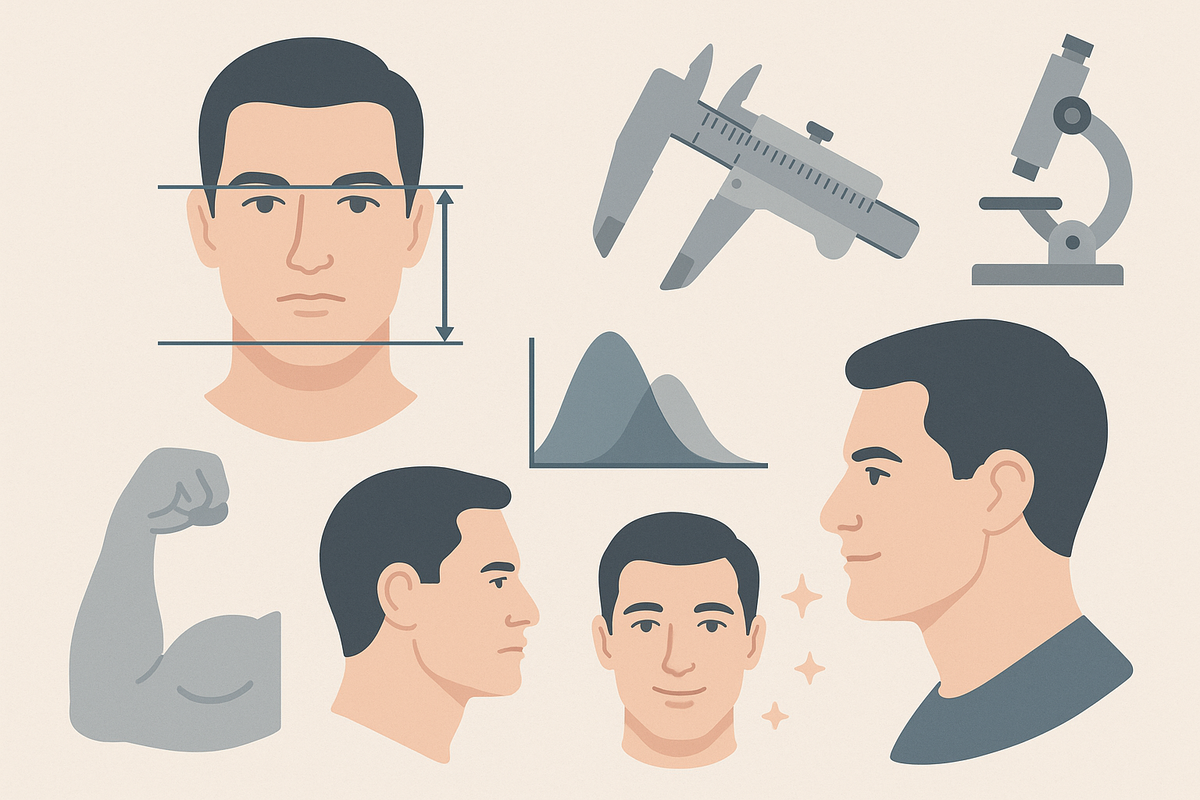
Estimated reading time: 14 min
Key Takeaways
- The FWHR ratio (facial width-to-height ratio) is a scientific measurement using cheekbone width and upper-face height.
- It's associated with masculinity, dominance, and sometimes perceived aggression, but not always with attractiveness.
- Accurate FWHR measurement depends on using the right facial landmarks and a neutral photo angle.
- Research links FWHR to testosterone, sports performance, and some behavioral traits, but findings are mixed.
- Apps like Maxx Report use AI to analyze your FWHR and other facial metrics for actionable looksmaxxing advice.
Table of Contents
- Section 1: Understanding FWHR Ratio — Definition and Origins
- Section 2: The FWHR Formula and Landmark Selection
- Section 3: How to Measure FWHR Ratio Correctly
- Section 4: Typical FWHR Ranges — What’s Normal?
- Section 5: What Does a High FWHR Ratio Mean?
- Section 6: FWHR Ratio and Attractiveness, Testosterone, and Success
- Section 7: Limitations, Caveats, and Myths Around FWHR
- Section 8: FWHR Ratio in Looksmaxxing and Aesthetics
- Conclusion
- FAQ
Section 1: Understanding FWHR Ratio — Definition and Origins
What Is FWHR Ratio?
The term FWHR ratio stands for facial width-to-height ratio. It’s a specific anthropometric measurement used in psychology, biology, and aesthetics to quantify the proportion between the width and height of the upper face. While facial ratios have been studied for centuries, FWHR rose to prominence in the last two decades as researchers searched for reliable, quantifiable correlates of masculinity, dominance, and even aggression.
Why Measure FWHR?
Unlike subjective impressions or vague terms like "strong jawline," the FWHR ratio offers a repeatable number. This makes it valuable in research, AI analysis, and looksmaxxing communities. The simple structure of the ratio also allows for comparison across individuals and populations.
- Psychology: Studied for links to dominance, trustworthiness, and aggression.
- Evolutionary Biology: Proposed as a marker of sexual dimorphism and testosterone exposure.
- Beauty and Aesthetics: Used in apps, plastic surgery, and looksmaxxing to quantify facial structure.
Historical Context
The first studies to popularize FWHR appeared in the mid-2000s. Researchers noticed that wider faces (higher FWHR) seemed more common among men, and hypothesized links to both evolutionary selection and hormone exposure. Since then, FWHR has been studied in athletes, CEOs, politicians, and the general public.
To see how FWHR fits into the broader science of facial proportions, check out our deep dive on the Golden Ratio Face.
Section 2: The FWHR Formula and Landmark Selection
The Standard FWHR Formula
At its core, the FWHR formula is simple:
- FWHR = Bizygomatic Width / Upper-Face Height
Let’s break down these terms:
- Bizygomatic Width: The horizontal distance between the left and right zygions (the widest points of the cheekbones).
- Upper-Face Height: The vertical distance from the highest point of the upper lip (vermilion) to the midpoint of the brow at the nasion (between the eyes).
Choosing the Right Landmarks
- Zygion (Cheekbone) Points: Found by tracing horizontally across the face at the widest part of the cheekbones.
- Nasion: The midline point at the top of the nose, right between the eyebrows. This is where the forehead meets the bridge of the nose.
- Upper Lip: The midpoint of the upper lip’s red border (vermilion border).
Consistency is crucial. Slight changes in landmark placement can skew the FWHR by several percent, leading to inaccurate comparisons.
Variations in Research
Some studies replace the nasion with the upper eyelids, or measure from the eyelid rather than the brow. The most accepted method is brow-to-lip, but always check the definition used if you’re comparing scores. Advanced facial analysis apps, such as Maxx Report, use precise AI landmark detection to eliminate human error.
Section 3: How to Measure FWHR Ratio Correctly
Step-by-Step Measurement Guide
Measuring the FWHR ratio accurately requires attention to detail. Here’s a stepwise process:
- Select a Neutral Photo: Use a well-lit, front-facing photo with a neutral expression. Avoid angles, tilts, or head rotation.
- Mark Cheekbone Points: Identify the widest horizontal points of the face (zygon to zygon).
- Mark Vertical Points: Measure from the midpoint of the upper lip’s vermilion border straight up to the midpoint between the brows (nasion).
- Measure Distances: Use a ruler or digital tool to measure both distances in pixels (if using a photo) or millimeters (for 3D scans).
- Calculate the Ratio: Divide the width by the height.
Common Pitfalls to Avoid
- Photo Angle: Even a slight tilt or turn can distort both width and height readings.
- Expression: Smiling or frowning alters facial landmarks, especially the lip and cheek areas.
- Lighting and Shadows: Poor lighting can obscure landmarks, especially the zygions and nasion.
AI-Assisted Analysis
Modern AI tools, like those in Maxx Report, automate landmark detection and measurement, reducing user error. Here’s a sample face feature analysis from the app:

This approach ensures consistency and enables users to compare their FWHR ratio to population averages or idealized standards with confidence.
Want to learn more about how AI analyzes your face shape? See our Face Shape Quiz guide.
Section 4: Typical FWHR Ranges — What’s Normal?
Average Values for Men and Women
Large-scale studies provide a clear picture of what constitutes a “normal” FWHR ratio:
- Men: Average FWHR ranges from 1.85 to 2.05
- Women: Average FWHR ranges from 1.75 to 1.95
Note: These are population averages; there is wide individual variation.
Distribution and Variation
- FWHR distribution is roughly normal (bell curve) in most populations.
- Some ethnic groups have slightly higher or lower averages, but differences are modest.
- Children and adolescents have lower FWHR values; the ratio increases with puberty and facial bone growth.
What Counts as High or Low?
- High FWHR: Generally over 2.05 in men, over 1.95 in women.
- Low FWHR: Below 1.80 in men, below 1.70 in women.
High FWHR is visually striking and often associated with a robust, “masculine” appearance. However, natural variation means that many healthy, attractive faces fall outside these ranges.
Section 5: What Does a High FWHR Ratio Mean?
Perceived Masculinity and Dominance
Much of the interest in FWHR ratio comes from its association with “masculine” or dominant traits. Studies have found:
- Men with higher FWHR scores are often rated as more dominant by observers.
- Some data suggest links to perceived aggression, threat, and assertiveness.
- These effects are seen across cultures but are stronger in men than women.
Behavioral Correlations
- Small-to-moderate studies link high FWHR to self-reported aggression, risk-taking, and even unethical behavior (e.g., in CEOs or athletes).
- Other studies find no significant behavioral links, suggesting that social context and individual differences play a major role.
Why Might FWHR Matter?
- Some researchers argue FWHR is a marker of pubertal testosterone exposure, which influences bone growth and facial development.
- Others suggest it evolved as a visual cue for social dominance or fighting ability, especially in ancestral groups.
Importantly, FWHR is only one feature among many that shape how faces are perceived. Features like eye size, jaw shape, and skin quality also play major roles. For more on one of these, see our article on Hunter Eyes.
Section 6: FWHR Ratio and Attractiveness, Testosterone, and Success
Is FWHR Linked to Attractiveness?
The relationship between FWHR ratio and attractiveness is complex. While a high FWHR can signal masculinity, studies show:
- Women do not consistently rate higher-FWHR men as more attractive.
- Extreme FWHR (very wide faces) can be seen as less trustworthy or too aggressive.
- Attractiveness depends on facial harmony, symmetry, and other proportions — not just FWHR.
This aligns with the broader science of facial attractiveness, where balance and proportion matter more than any single metric. For a deeper look, see our post on the Golden Ratio Face.
Testosterone and Physiological Links
- Some research suggests a weak correlation between higher FWHR and higher testosterone, especially during puberty.
- But not all large studies support this, and adult testosterone levels may not predict FWHR.
Success, Sports, and Social Power
- Studies of athletes and CEOs show those with higher FWHR may be overrepresented in competitive roles.
- However, the effect sizes are modest, and there are many exceptions.
- FWHR does not “cause” success, but may influence first impressions in leadership or high-stakes environments.
Section 7: Limitations, Caveats, and Myths Around FWHR
Measurement Issues
- Landmark Variability: Small differences in where you place measurement points can shift the ratio.
- Photo Quality: Blurry, angled, or shadowed photos yield unreliable results.
- Expression and Age: Smiling, aging, or facial fat can alter perceived FWHR without changes in bone structure.
Mixed and Contradictory Findings
- Not all studies replicate strong links between FWHR and behavior, testosterone, or social outcomes.
- FWHR is only weakly linked to real-world aggression or unethical conduct.
Myths and Overstatements
- Myth: High FWHR always means high testosterone. Reality: The link is subtle and not deterministic.
- Myth: FWHR determines attractiveness. Reality: It’s just one piece of the puzzle.
- Myth: You must “max out” FWHR to look good. Reality: Proportion and harmony matter most.
For a look at how automated recommendations weigh multiple factors — not just FWHR — see our article on how AI beauty recommendations work.
Section 8: FWHR Ratio in Looksmaxxing and Aesthetics
FWHR in the Looksmaxxing Community
Within looksmaxxing circles, the FWHR ratio is often discussed as a “masculinity score.” Some enthusiasts chase a higher FWHR through mewing, facial exercises, or even surgery. However, most experts and advanced AI tools (like Maxx Report) focus on overall facial balance, not just maximizing this ratio.
“Ideal” or “Best” FWHR Ratio
- No universal “best” FWHR exists. Many sources cite 2.0–2.1 as close to the “ideal” for men, aligning with research averages.
- Women’s “ideal” FWHR is usually quoted as 1.8–1.9, but again, harmony with other features is key.
Chasing an extreme FWHR rarely leads to better results. Instead, focus on overall facial proportions, symmetry, and how features work together.
Role of AI-Powered Analysis
Apps like Maxx Report use advanced algorithms to assess not only your FWHR ratio but also jawline, symmetry, skin quality, and more. The report offers a transformation plan that considers all relevant metrics for a holistic “glow up.”
For actionable tips to improve your facial aesthetics, see our guide to AI glow up tips.
Conclusion
The FWHR ratio is a powerful, research-backed tool for quantifying facial structure. It reflects the width of your cheekbones relative to the height of your upper face, and has been linked to masculinity, dominance, and social perceptions. While a higher FWHR can signal certain traits, it is not a magic bullet for attractiveness or success. The best approach is a holistic one that values facial harmony and overall health.
If you’re curious about your own FWHR ratio and how it fits into your personal transformation journey, try a comprehensive AI-powered analysis with Maxx Report.
FAQ
Q: What does FWHR stand for?
A: FWHR stands for Facial Width-to-Height Ratio. It’s the ratio of the width of your face (cheekbone to cheekbone) to the height (from the upper lip to the midpoint between the eyebrows).
Q: How do you measure facial width-to-height ratio?
A: Use a front-facing photo. Measure the distance between the widest points of your cheekbones (bizygomatic width), then from the top of your upper lip to the midpoint between your brows (upper-face height). Divide width by height to get your FWHR.
Q: What is a normal or average FWHR?
A: For men, the average FWHR is about 1.85-2.05. For women, it’s roughly 1.75-1.95. These numbers are based on large population studies.
Q: Is a higher FWHR considered more masculine or dominant?
A: Yes, higher FWHR scores are often associated with a more masculine and dominant appearance, especially in men. However, balance with other facial features is important for attractiveness.
Q: Does FWHR predict attractiveness or testosterone?
A: FWHR may weakly signal testosterone exposure during puberty, but it’s not a direct marker of current testosterone. Attractiveness is influenced by many factors, not just FWHR.
Q: What is the ideal FWHR for men?
A: Many sources suggest 2.0–2.1 as the “ideal” FWHR ratio for men, but real-world attractiveness depends on overall harmony, not just this number.