
Facial Thirds and Fifths: The Pillar Guide to Harmony, Ratios, and Measurement
Facial thirds and fifths explained: learn how to measure facial harmony, golden ratio face, canthal tilt, symmetry, and FWHR. Essential guide for attractiveness.

Estimated reading time: 15 min
Key Takeaways
- Facial thirds and fifths are essential tools for analyzing facial harmony and aesthetics.
- They provide a standard way to measure vertical and horizontal facial proportions.
- Landmarks like trichion, glabella, subnasale, and canthi are crucial for accuracy.
- Understanding ratios, symmetry, and the golden ratio can guide beauty and cosmetic decisions.
- Real-world applications range from aesthetics to plastic surgery and AI looksmaxxing apps like Maxx Report.
Table of Contents
- Section 1: What Are Facial Thirds and Fifths?
- Section 2: How to Measure Facial Thirds – Step-by-Step
- Section 3: Measuring Facial Fifths and Key Landmarks
- Section 4: Ideal Ratios, Golden Ratio Face, and Real-World Faces
- Section 5: Related Metrics – FWHR, Canthal Tilt, and Symmetry
- Section 6: Practical Applications and Limitations in Beauty Analysis
- Conclusion
- FAQ
Section 1: What Are Facial Thirds and Fifths?
Defining Facial Thirds and Fifths
Facial thirds and fifths are two foundational concepts in facial analysis, used by plastic surgeons, artists, orthodontists, and AI apps like Maxx Report to evaluate facial harmony. They provide a systematic way to break down the face into measurable, proportional zones that help assess balance and attractiveness.
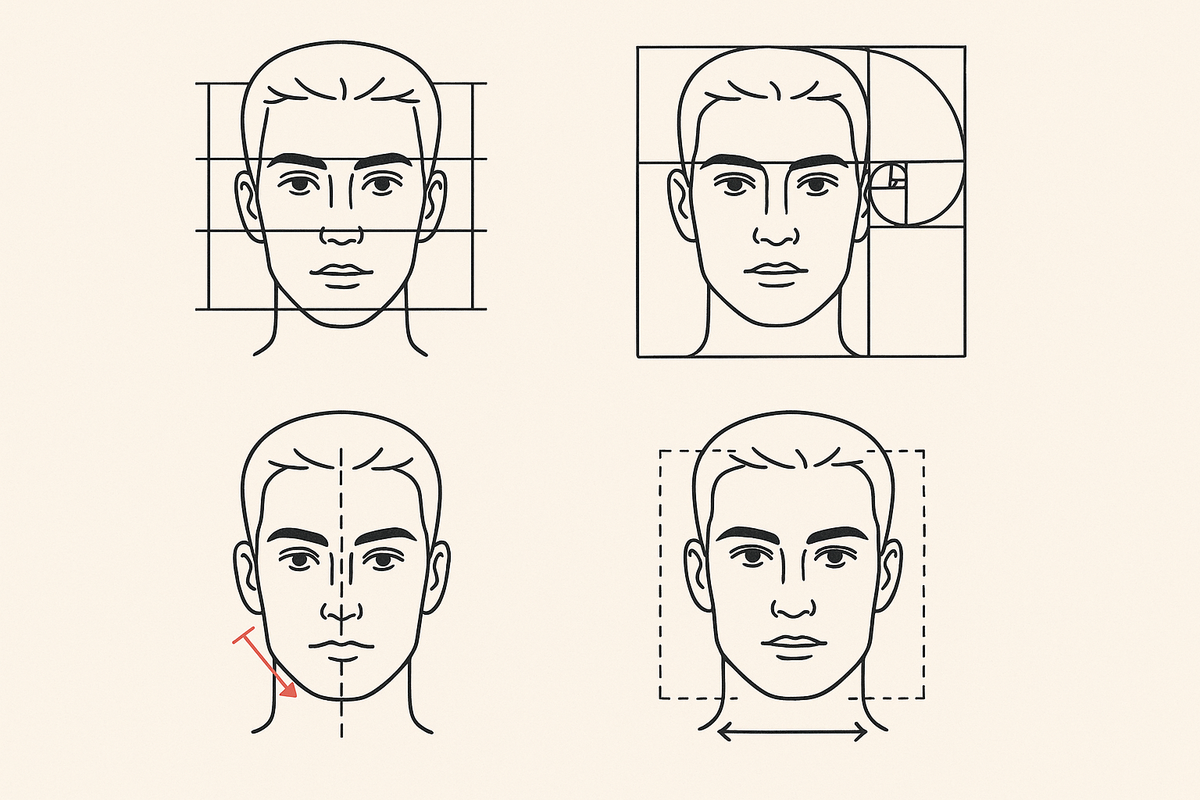
- Facial Thirds: The face is divided horizontally into three equal zones — upper, middle, and lower thirds. This method gives a clear way to assess vertical facial balance and helps identify if one area of the face is disproportionately long or short. For example, the area from the hairline to the brow (upper third), brow to base of nose (middle third), and nose base to chin (lower third) are compared for evenness.
- Facial Fifths: The face is divided vertically into five equal sections (like vertical stripes) across the width of the face. Each fifth is approximately one eye-width, providing a template for horizontal symmetry. This approach can highlight if the nose is overly wide, if the eyes are set too close or far apart, or if the face appears too broad or narrow in certain regions.
Why Measure Thirds and Fifths?
These measurements help answer the question, "How attractive is my face?" by providing objective standards. They are critical for:
- Evaluating facial harmony and symmetry, which are consistently linked with perceptions of beauty in psychological and anthropometric research.
- Planning cosmetic surgery or orthodontic treatment. Surgeons use these divisions to decide where to add or remove volume, reposition features, or plan jaw and nose surgeries for optimal proportionality.
- Understanding deviations that create the impression of a long, short, wide, or narrow face. For example, a lower third that is longer than the other two may indicate a protrusive chin or a long upper lip, which can influence diagnosis and treatment in orthodontics.
- Guiding digital makeovers and AI-based beauty reports. Applications like Maxx Report automate these calculations, offering users a detailed breakdown and personalized suggestions for improvements or enhancements based on their unique facial structure.
Thirds vs Fifths: Vertical and Horizontal Assessment
While facial thirds focus on the vertical dimension, facial fifths measure the horizontal spread. Both are needed for a comprehensive analysis of facial proportions and harmony. For instance, a person may have perfectly balanced vertical thirds but an excessively wide central fifth, which could draw attention to the nose. Conversely, someone with balanced fifths but a long lower third might appear to have a receding or protruding chin. These analyses are complementary and together provide a nuanced view that supports both aesthetic evaluation and medical planning.
Section 2: How to Measure Facial Thirds – Step-by-Step
Key Landmarks for Thirds
To measure the facial thirds accurately, you need to locate precise anatomical points. Consistency in identifying these points is critical for reliable results. The main landmarks are:
- Trichion: The midpoint at the top of the forehead where the hairline begins. In individuals with receding hairlines or baldness, the trichion may be estimated by the natural starting point of the hair or by using averages based on facial height.
- Glabella: The smooth area between the eyebrows. This is an easily identifiable bony area and serves as the dividing point between the upper and middle third.
- Subnasale: The base of the nose where it meets the upper lip. The subnasale marks the transition from the middle to the lower third and is crucial for assessing the length of the philtrum (the groove between the nose and upper lip).
- Menton: The lowest point on the chin. Accurate identification of the menton is important, especially in cases of chin asymmetry or prominent jaws.
Dividing the Face: Upper, Middle, and Lower Thirds
Follow these steps for accurate division:
- Upper Third: From trichion (hairline) to glabella (between eyebrows). This zone includes the forehead, which contributes to perceived youthfulness and facial openness. A high or low forehead can affect the balance of the face.
- Middle Third: From glabella to subnasale (base of nose). The middle third encompasses the eyes, brows, and nose bridge. Disproportionately long or short middle thirds may indicate a high or low nasal bridge, impacting both aesthetic and functional aspects.
- Lower Third: From subnasale to menton (chin). The lower third includes the lips and chin, playing a major role in perceived masculinity or femininity. Variations here can impact lip fullness, chin projection, and overall facial strength.
Each of these thirds should ideally be of equal length. A 1:1:1 ratio is considered harmonious, but natural variation is common. For example, many attractive faces feature a slightly shorter upper third, which is often associated with youth, or a slightly longer lower third, which can impart a strong jawline. Studies in different populations have shown that even among models and celebrities, the ratios can vary by up to 10% from the ideal, without detracting from perceived attractiveness.
Tips for Accurate Measurement
- Take a straight-on, well-lit photo with a neutral expression. Shadows or facial expressions like raising the brows can alter the apparent position of landmarks.
- Use a ruler or digital caliper; many apps (including Maxx Report) automate this process and can highlight the landmarks for you. Some digital tools allow you to overlay a grid on your photo, making proportional analysis easier and more precise.
- Mark the landmarks carefully for best results. Double-check their positions by referencing anatomical illustrations or using an app with guided landmark placement. Inconsistent placement can lead to significant errors in ratio calculations.
Imbalances may suggest a long lower face (if the lower third is largest), or a short upper face (if the upper third is smallest). For example, orthodontists often see patients with a long lower third due to excessive vertical growth of the jaw, which can cause bite problems as well as aesthetic concerns. Conversely, a short lower third may indicate a recessed chin or underdeveloped mandible. Understanding facial thirds is also foundational for more advanced ratios, like the golden ratio face concept, and helps in planning treatments such as genioplasty (chin surgery), rhinoplasty (nose surgery), and non-surgical aesthetic enhancements like fillers.
Section 3: Measuring Facial Fifths and Key Landmarks
How to Measure Facial Fifths
Facial fifths evaluate the horizontal dimension. The face is divided by vertical lines into five equal parts, each roughly the width of one eye. This system is particularly helpful for assessing the relationships between the eyes, nose, and outer face width. The five divisions are:
- First fifth: From the outer edge of one ear to the outer corner of the eye (lateral canthus). This region often includes the temple and can indicate if the face is broad at the sides.
- Second fifth: From the outer corner of the eye to the inner corner (medial canthus). This is essentially the width of one eye and should be similar in size to the other fifths.
- Third fifth (center): From inner canthus to inner canthus (across the nose). The central fifth encompasses the width of the nose and philtrum. A broader or narrower nose will be reflected here.
- Fourth fifth: Inner to outer canthus (other eye). Mirrors the second fifth, and discrepancies between these two may indicate eye asymmetry.
- Fifth fifth: Outer canthus to outer edge of the other ear. Like the first fifth, this area covers the temple and lateral face region.
Critical Landmarks in Fifths Analysis
- Inner canthi: The points where the eyelids meet near the nose. These are used to measure the intercanthal distance, which can indicate if the eyes are wide-set or close-set.
- Outer canthi: Where the eyelids meet at the temple side. The distance between outer canthi is a reference for facial width and helps in assessing canthal tilt (angle of the eyes).
- Alar base: Outer edges of the nostrils. The width of the alar base is compared to the width of the eyes and the central fifth to assess proportionality and nasal aesthetics.
The width of each eye (measured from inner to outer canthus) is the template for each fifth. The ideal face has five equal vertical sections across its width, with the nose width matching the central fifth. For example, if the eye width is 30mm, then the ideal nose width and each fifth would also be 30mm, leading to a total face width of approximately 150mm across the five fifths.
Common Variations and What They Indicate
- If the central fifth (nose/philtrum) is wider than one eye-width, the nose may appear broad. This can be a natural ethnic variation or result from nasal cartilage growth.
- If the outer fifths are large, the face may seem wide/splayed. This is sometimes seen in square or rectangular face shapes and can give a more masculine appearance, though it may also be associated with aging as the temples hollow.
- Narrow central fifths can create a sharp, narrow nose impression, often perceived as delicate or refined but sometimes associated with breathing difficulties if the nostrils are too narrow.
Analyzing fifths is vital for understanding facial width/height ratio (FWHR) and for procedures that alter eye, nose, or cheek structure. For example, rhinoplasty surgeons use fifths analysis to plan nose reshaping that harmonizes with the eyes and overall facial width. For a deeper dive into facial shape and its impact, see the face shape quiz with AI analysis. Furthermore, fifths analysis is also used in makeup artistry to contour and highlight features, creating the illusion of greater balance or symmetry.
Section 4: Ideal Ratios, Golden Ratio Face, and Real-World Faces
The Ideal Ratios: What is Harmonious?
- Facial Thirds: The classic ideal is a 1:1:1 (33% each) ratio from forehead to chin. This means, for a typical adult face of 180mm from hairline to chin, each third would be about 60mm.
- Facial Fifths: Each fifth is about 20% of the total facial width, or one eye-width. For a face 150mm wide, each fifth would be 30mm. The central fifth, corresponding to the nose and philtrum, is ideally the same as the eye width, anchoring the facial features in a balanced arrangement.
These metrics stem from Renaissance art and anthropometric studies. Famous artists like Leonardo da Vinci used these proportions as a blueprint for idealized human faces. The ratios serve as a guideline, not a strict rule — variation is both natural and culturally influenced. For example, East Asian populations often have slightly wider central fifths due to broader nasal bases, while Northern European populations may have narrower central fifths and wider outer fifths.
Golden Ratio Face: Myth or Science?
The golden ratio face concept is based on the mathematical constant φ (phi, ≈1.618). Proponents claim that faces with proportions close to the golden ratio are perceived as most attractive. For instance, the ideal distance between the eyes divided by the width of the mouth, or the length of the face divided by the width, should approximate 1.618. In practice, few real faces match this exactly, but the golden ratio often overlaps with harmonious thirds and fifths. Some facial measurements commonly compared to the golden ratio include:
- The length of the face divided by the width of the face
- The distance between the pupils divided by the distance from the brow to the hairline
- The width of the mouth divided by the width of the nose
While the golden ratio is an interesting mathematical ideal, studies have shown that what people find attractive often deviates from its exact proportions. The appeal of the golden ratio may be more about general balance and harmony than strict adherence to a number. For a detailed exploration, read The Science of Perfect Facial Proportions.
Real Faces: Diversity and Beauty
- Many attractive faces deviate from the 'ideal' ratios. For example, celebrities such as Angelina Jolie and Benedict Cumberbatch have notable deviations yet are widely regarded as attractive, showing that uniqueness can be appealing.
- Facial harmony is more about relative balance than meeting a strict standard. A slightly larger nose may be balanced by fuller lips or a strong jawline, maintaining overall harmony.
- Other factors like symmetry, skin quality, and expression play a major role. A symmetrical face with clear skin and a genuine smile may be rated more attractive than a mathematically perfect but expressionless face.
AI-powered analysis, as in Maxx Report, uses these ratios as part of a holistic evaluation, not as the sole measure of attractiveness. The app also incorporates factors such as color balance, skin smoothness, and dynamic expressions to provide a more comprehensive assessment. This approach mirrors the real-world complexity of facial beauty, where ratios are a starting point, not the final word.
Section 5: Related Metrics – FWHR, Canthal Tilt, and Symmetry
FWHR: Facial Width to Height Ratio
FWHR (Facial Width Height Ratio) is calculated by dividing the bizygomatic width (cheekbone to cheekbone) by the upper facial height (mid-brow to upper lip). This ratio is used in both psychological research and cosmetic analysis:
- High FWHR: Wider, more angular face, often linked with perceived dominance, assertiveness, and in some studies, leadership ability. For men, a higher FWHR is associated with masculinity and has been correlated with higher success in competitive or aggressive environments.
- Low FWHR: Longer, narrower face, often perceived as more delicate or refined. This can be attractive in both men and women, depending on other facial features and cultural norms.
FWHR is a popular metric in both facial attractiveness research and digital looksmaxxing tools. In practical terms, the average FWHR for men is around 1.85, while for women, it tends to be closer to 1.75. However, these numbers vary by ethnicity and age. In cosmetic surgery, FWHR can guide cheekbone augmentation or jaw reduction procedures to achieve a more harmonious balance.
Canthal Tilt: What is It and Why Does It Matter?
The canthal tilt refers to the angle between the inner and outer corners of the eyes. It's measured by drawing a line between the inner canthus (closest to the nose) and the outer canthus (towards the ear). The ideal canthal tilt is usually considered to be between 2-8 degrees upward.
- Positive canthal tilt: Outer canthus is higher than the inner; associated with youthfulness and attractiveness. It gives the eyes an almond shape, which is often seen as alert and energetic.
- Negative canthal tilt: Outer canthus is lower; can give a tired or sad appearance. This is sometimes associated with aging or certain genetic conditions.
Canthal tilt influences perceived emotion and energy levels. In cosmetic procedures such as canthoplasty or eyelid surgery, surgeons often aim to create or accentuate a positive canthal tilt for a more aesthetically pleasing result. For more information on eye shape and its significance, see Hunter Eyes: Definition, Benefits, and How to Achieve Them.
Facial Symmetry: The Cornerstone of Harmony
Symmetry is a key component in beauty standards across cultures. While perfect symmetry is rare, higher degrees of symmetry are often perceived as more attractive. Studies have shown that people can detect even minor asymmetries, and these can influence social and romantic perceptions. For example, a study published in "Proceedings of the Royal Society B" found that faces with greater symmetry were consistently rated as more attractive, regardless of cultural background.
- Facial thirds and fifths help quantify symmetry. For example, if the left and right fifths differ significantly, or one third is obviously longer or shorter, the face may appear asymmetrical.
- Asymmetries can be subtle or pronounced, affecting perception. Minor asymmetries are common and can even add character, but marked differences may be associated with underlying medical conditions or developmental factors.
Maxx Report and similar apps use AI to map these proportions and provide a symmetry score as part of their reports. The software can detect differences as small as 1-2mm, which are often imperceptible to the naked eye but may still impact perceived attractiveness. Symmetry analysis can also help track changes over time, such as the effects of aging, dental work, or cosmetic procedures.
Section 6: Practical Applications and Limitations in Beauty Analysis
Applications in Cosmetic and Reconstructive Fields
Facial thirds and fifths are foundational in:
- Plastic and reconstructive surgery planning. Surgeons use these proportions to guide procedures like rhinoplasty, facelifts, and chin augmentation, aiming for results that align with or enhance the patient's natural balance.
- Orthodontics and maxillofacial procedures. Correcting jaw misalignments or dental occlusions often involves restoring or improving third and fifth ratios, especially in cases of underbite, overbite, or facial asymmetry.
- Makeup and fashion consulting (see AI Fashion Consultant: Revolutionizing Personal Style in 2024). Makeup artists use third and fifth analysis to contour, highlight, and shade the face for optimal proportions, such as narrowing the nose with highlighter or widening the eyes with eyeliner.
- AI looksmaxxing and digital glow-up apps. Maxx Report and similar tools use automated measurements to suggest personalized recommendations, such as facial exercises, skincare regimens, or even hairstyle changes to improve apparent balance.
Limitations: The Impact of Angle, Pose, and Distortion
- Pose: Turning or tilting the head distorts true proportions. For instance, a slight head tilt can artificially lengthen or shorten one side of the face, misleading the analysis.
- Lens distortion: Wide-angle lenses exaggerate features, skewing measurements. Photos taken too close to the face can make the nose look larger and the cheeks appear wider.
- Lighting and expression: Shadows and facial movement can affect perceived ratios. Smiling, frowning, or raising the brows can all alter the position of key landmarks, changing the calculated thirds and fifths.
It’s important to use standardized, neutral photos for analysis. Ideally, photos should be taken at eye level, with the camera about 1.5 meters away, using a lens with a focal length of 50-85mm for minimal distortion. AI tools like Maxx Report are trained to correct for some distortions, using algorithms to estimate true landmark positions, but manual review is still recommended for critical decisions such as surgical planning or orthodontic evaluation. For the highest accuracy, multiple photos from different angles may be analyzed and averaged.
Understanding the Bigger Picture of Attractiveness
- Facial thirds and fifths are just one piece of the puzzle. A mathematically balanced face may still be perceived as unattractive if skin health, grooming, or emotional expression is neglected.
- Traits like skin quality, jawline definition, and overall health matter greatly. For example, clear skin and a defined jawline can enhance attractiveness, even if the underlying ratios are not ideal.
- Personal and cultural standards of beauty evolve over time. In some cultures, high cheekbones and fuller lips are prized; in others, narrow noses or larger eyes take precedence. Social trends and media representations also influence perceptions of beauty, making the "ideal" a moving target.
For practical grooming and transformation tips, explore the Ultimate Grooming and Skincare Guide for Men or try a digital analysis with Maxx Report for a personalized plan. Remember, the most successful transformations are holistic, combining ratio analysis with attention to lifestyle, grooming, and self-confidence.
Conclusion
Facial thirds and fifths provide a robust, time-tested framework for understanding facial harmony, aesthetics, and attractiveness. By breaking down the face into vertical and horizontal segments, these systems offer insight into what creates a balanced, appealing look — but they are not the whole story. Symmetry, the golden ratio, FWHR, canthal tilt, and individual traits all play a role. Whether you are considering aesthetic changes, seeking to understand your unique beauty, or simply curious about "how attractive is my face," these tools can guide you — especially when combined with AI-powered apps like Maxx Report. Always remember that real beauty is a sum of many parts, and harmony often matters more than perfection. Embracing your natural structure and enhancing your strengths, rather than chasing an unattainable ideal, leads to the most authentic and lasting attractiveness. Use these measurements as a guide, not a rule, and celebrate the diversity that makes each face unique.
FAQ
Q: What are facial thirds and fifths in facial analysis?
A: Facial thirds divide the face vertically into upper, middle, and lower sections; fifths divide it horizontally into five equal parts, each about an eye-width, to assess harmony and balance.
Q: How do you measure facial thirds accurately?
A: Mark the trichion (hairline), glabella (brow), subnasale (nose base), and menton (chin). Measure the distances between these points to divide the face into three equal vertical thirds.
Q: How do you measure facial fifths on a face?
A: Use the width of one eye (inner to outer canthus) as a base. The face should have five vertical segments of this width from ear to ear, with the nose spanning the central fifth.
Q: What is the ideal ratio for facial thirds and fifths?
A: The classic ideal is a 1:1:1 ratio for thirds (each third equal) and five equal fifths horizontally (each one eye-width). Deviations are common and can still be attractive.
Q: What landmarks are used for the rule of facial fifths?
A: Key landmarks include the inner and outer canthi (eye corners), alar base (nostril edges), and the outer edges of the face, aligning each fifth to the width of the eye.
Q: Are facial thirds and fifths reliable for judging attractiveness?
A: They provide a helpful framework for analyzing balance and harmony but are only one part of overall attractiveness, which also includes symmetry, skin quality, expression, and cultural factors.