
Glasses by Face Shape: The Ultimate Guide to Choosing Your Perfect Frames
Discover the best glasses by face shape. Learn how to find your face shape, match frames and colors, and choose glasses that elevate your style in 2026.
Estimated reading time: 15 min
Key Takeaways
- Identifying your face shape is the first step to finding the best glasses for your look.
- Each face shape—oval, round, square, heart, diamond, triangle, rectangle—has frames that flatter its unique features.
- Bridge fit and pupillary distance are crucial for both comfort and style.
- Color coordination with skin tone and hair color brings your eyewear style to life.
- 2026 trends blend quiet luxury and bold statements, making the right choice even more important.
Table of Contents
- Section 1: How to Identify Your Face Shape
- Section 2: The Primary Face Shapes Explained
- Section 3: Best Glasses for Round, Square, and Heart Faces
- Section 4: Glasses for Oval, Diamond, and Triangle Faces
- Section 5: Fit Factors Beyond Shape—Bridge, PD, and Comfort
- Section 6: Color Coordination and 2026 Eyewear Trends
- Conclusion
- FAQ
Section 1: How to Identify Your Face Shape
Mirror Tracing Method
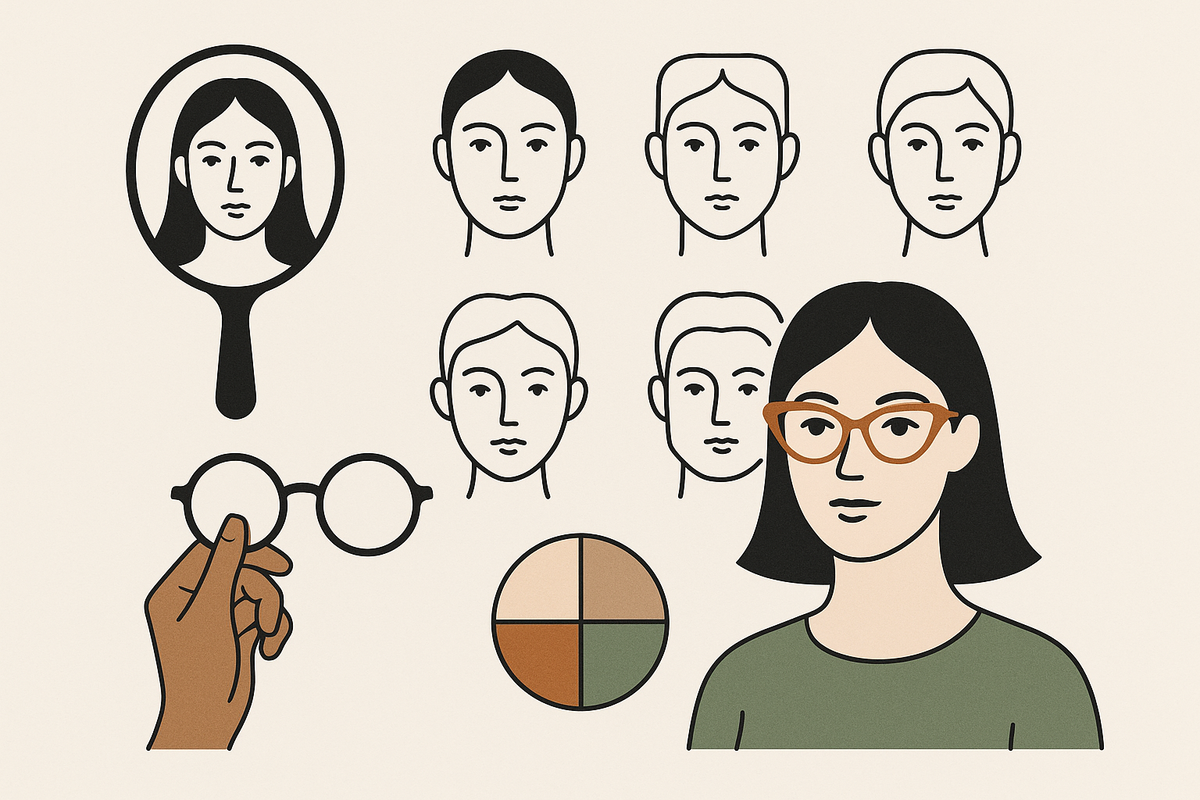
Stand in front of a mirror with your hair pulled back. Using a washable marker (or lipstick), trace the outline of your face on the mirror. Step back and observe the shape you’ve drawn—does it look oval, round, square, heart-shaped, or something else? This simple method gives a fast, visual clue to your face shape, which is the foundation for choosing glasses by face shape.
For even greater accuracy, do this in natural lighting and ensure your posture is upright. Take note of the widest and narrowest points of your outline. Pay attention to the curve of your chin and jaw, and whether your cheekbones are the most prominent feature. If you have facial asymmetry (most people do), repeat the process and look for the general trend. If the outline changes significantly with small head movements, you may be between two shapes; in that case, consider both when choosing frames.
Taking Accurate Measurements
- Forehead width: Measure across the widest part of your forehead.
- Cheekbone width: Measure from the outer corner of one eye to the other.
- Jawline width: Measure from jaw angle to jaw angle.
- Face length: Measure from your hairline to the bottom of your chin.
Compare these measurements: Is your face longer than it is wide? Are your cheekbones or jaw more prominent? The proportions will indicate your face shape category.
For the most precise results, use a flexible tape measure and record your measurements in millimeters. Here’s a step-by-step guide:
- With your hair pulled back, measure your forehead at its widest point, usually midway between your eyebrows and hairline.
- Measure across your cheekbones by placing the tape just below the outer corners of your eyes.
- Find your jawline’s widest points (below your ears) and measure straight across.
- For face length, start at the center of your hairline and run the tape down over your nose to the very tip of your chin.
Write down each number. If your face length is about the same as your width, you likely have a round or square face; if your face is longer, you might be oval, rectangle, or diamond. Prominent cheekbones suggest diamond; a wide jaw suggests triangle or square. Use these precise measurements with visual cues for a comprehensive assessment.
Photo Analysis and AI Tools
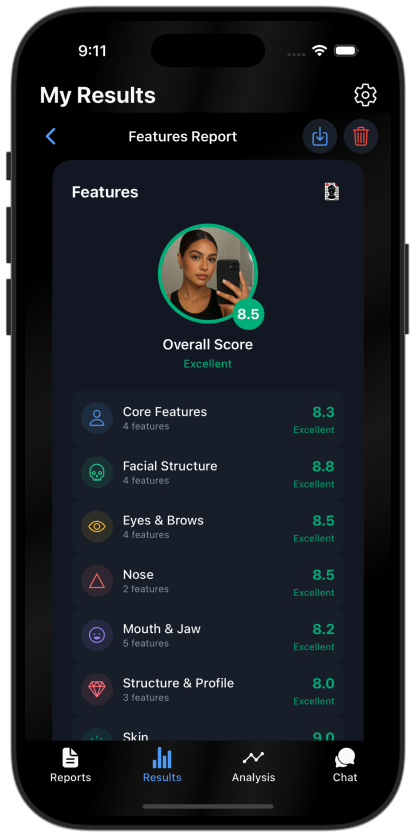
Snapping a straight-on photo in natural lighting and analyzing proportions can help, especially when paired with AI. Apps like Maxx Report automatically scan your face, rate features like jawline and symmetry, and provide a detailed assessment. For a deeper dive, try the Face Shape Quiz for an instant, personalized analysis.
Modern AI tools don’t just classify your face as a single shape—they also analyze secondary traits, such as the tilt of your eyes, the prominence of your brow, and the fullness of your cheeks. Some, like Maxx Report, use advanced facial landmark detection to map dozens of points on your face, calculating precise ratios (like the golden ratio) and offering 3D overlays for extra accuracy. This tech can even compare your proportions to celebrity face shapes, giving you style inspiration based on people who share your exact features.
Once you know your face shape, you’re ready to explore the best glasses for your face. Let’s break down the options.
Section 2: The Primary Face Shapes Explained
The 7 Essential Face Shapes
- Oval: Balanced proportions, slightly wider cheekbones, gently curved jawline.
- Round: Equal width and length, soft curves, minimal angles.
- Square: Prominent jawline, broad forehead, angular features.
- Heart: Wide forehead, high cheekbones, narrow chin.
- Diamond: Narrow forehead and chin, pronounced cheekbones.
- Triangle (Base Down): Jaw wider than forehead, strong jawline.
- Rectangle (Oblong): Face is much longer than it is wide, straight sides.
Quick Visual Characterization
Not sure which category you fall into? If your face has more length than width with a gently rounded chin, it’s likely oval. Strong, boxy jaw? Think square. Pointed chin with a wider brow? Probably heart-shaped. A sharp, angular jaw and a forehead as wide as the jaw signals rectangle. Cheekbones wider than both forehead and jaw indicate diamond. If your jaw is widest, triangle is your likely category. Use your measurements and visual cues together for the most accurate assessment.
Let’s break down a few examples:
- Oval: Anne Hathaway and Idris Elba are classic oval faces—balanced, with no one feature dominating.
- Round: Chrissy Teigen and Leonardo DiCaprio (in his 20s) have circular faces with soft, full cheeks and gentle chins.
- Square: Angelina Jolie and Brad Pitt are famous for their strong, square jaws and broad foreheads.
- Heart: Reese Witherspoon’s wide brow and narrow, pointed chin define the heart shape.
- Diamond: Rihanna and Benedict Cumberbatch show pronounced cheekbones, narrow chin and forehead.
- Triangle: Kelly Osbourne’s face is widest at the jaw, narrowing at the forehead.
- Rectangle: Sarah Jessica Parker’s face is longer than it is wide, with a strong, angular jaw.
Check your own face against these references, both visually and with measurements, for the clearest result.
Why Face Shape Matters for Glasses
Each face shape interacts differently with glasses frames. For example, glasses for round face types often focus on adding definition, while frames for face shapes with strong angles (like square) aim to soften and balance. By understanding your foundational face shape, you set yourself up for eyewear success—and avoid common style pitfalls.
Frame geometry can accentuate or balance your features. For instance, rectangular frames on a round face create structure, while round frames on a square face soften harsh features. Heart-shaped faces need frames that draw attention downward, while triangle faces benefit from styles that broaden the appearance of the forehead. Ultimately, the right frames can highlight your best features and downplay areas you wish to soften, making face shape the single most important starting point for glasses shopping.
Section 3: Best Glasses for Round, Square, and Heart Faces
Glasses for Round Face: Add Definition
- Best choices: Rectangular, geometric, and upswept cat eye frames.
- Why: These frames create contrast and sharpen soft features, making the face appear slimmer and longer.
- Avoid: Small or perfectly round frames, which can exaggerate fullness.
When searching for glasses by face shape, round-faced individuals should prioritize angular lines and bold edges. Try a browline or strong bridge for extra structure—this draws attention upward and elongates the face.
Concrete example: If your face measures 140mm wide and 140mm long, with soft jaw and cheek curves, a 52mm rectangular frame will add verticality. Geometric frames, such as hexagons, can make your cheeks look less prominent. Cat eye frames with an upswept browline visually lift the face. For color, dark or high-contrast frames (like black or navy) help define the face’s outline, while translucent or pastel frames may make roundness more pronounced.
Best Glasses for Square Face: Soften the Angles
- Best choices: Oval, round, or slightly curved frames.
- Why: These shapes contrast with your angular jaw and forehead, creating balance and a softer look.
- Avoid: Boxy, geometric frames that echo the jaw’s sharpness.
Look for frames with thinner rims or lighter colors, as these further reduce harshness. Glasses for downturned eyes can also work well for square faces, as upswept corners lift the face visually.
Practical tip: A 50mm round frame with a thin gold rim will soften a 140mm-wide jaw. Choose frames with subtle gradients or ombré coloring—this distracts from angularity. Rimless or semi-rimless styles also work well. If your jaw is particularly wide, avoid frames that extend beyond your face, as they’ll make your features look boxier.
Heart-Shaped Face: Balance the Brow
- Best choices: Light-colored or rimless frames, cat eye, or frames that are wider at the bottom.
- Why: These frames balance a wide forehead and narrow chin, drawing focus downward.
- Avoid: Heavy browline frames that emphasize the upper face.
Look for styles that soften the forehead without adding bulk, like delicate metals or subtle geometric elements.
For heart shapes, rimless frames with a gentle curve at the bottom help de-emphasize a broad forehead. Cat eye frames should have a subtle upsweep, not an exaggerated one, to avoid pulling attention upward. For a modern twist, try frames in blush or clear acetate. If you have a prominent widow’s peak or a very pointed chin, avoid frames with strong upper corners that make the brow seem broader.
For a highly personalized match, consider using an AI-powered tool such as Maxx Report, which accounts for subtle features like eye tilt and cheekbone prominence in its recommendations. For more on how technology can revolutionize your look, read AI Fashion Consultant: Revolutionizing Personal Style in 2024.
Section 4: Glasses for Oval, Diamond, and Triangle Faces
Oval Face: The Versatile Standard
- Best choices: Almost any frame shape! Square, round, aviator, geometric, or bold statement frames.
- Why: Oval faces have balanced proportions, so most frames will complement the natural symmetry.
- Avoid: Frames that are too oversized or too narrow for your features.
This versatility makes shopping for the best glasses for my face easy if you’re oval-shaped. Experiment with trends, color, and edgy styles—just ensure proper fit.
Example: If your face measures 150mm long and 135mm wide, you can pull off thick acetate frames, aviators, or even bold geometric shapes. However, frames that are wider than your face by more than 5mm on each side may overwhelm your features. Try to keep the frame width within the range of your cheekbones for the most flattering look. If you prefer subtlety, rimless or thin wire frames will showcase your symmetry without distraction. Ovals can also handle bright or unconventional colors—consider bold reds, blues, or even translucent neons if you want to stand out.
Diamond Face: Highlight Unique Features
- Best choices: Rimless, oval, or cat eye frames. Frames with pronounced brow lines or upswept corners.
- Why: These highlight cheekbones and soften narrow jawlines and foreheads.
- Avoid: Narrow frames that exaggerate width at the cheekbone.
Diamond faces benefit from expressive, distinctive eyewear—think geometric or statement frames that draw attention to the eyes.
If your cheekbones are the widest point (e.g., 145mm cheekbones, but 120mm forehead and jaw), select frames with a dramatic browline to add width to your forehead. Cat eye frames with subtle embellishments give lift and highlight your cheekbones. Rimless or semi-rimless frames can soften the overall effect if you want a more understated look. Avoid tiny or overly narrow frames, as they can make your cheeks look even wider by comparison. Try a deep green or blue frame to accentuate your eyes and cheekbones.
Triangle Face: Balance the Jaw
- Best choices: Frames with detailing on the upper half (browline, cat eye), aviators, or D-frames.
- Why: These broaden the appearance of the forehead, balancing a wider jaw.
- Avoid: Bottom-heavy frames, which can further emphasize the jaw.
If you’re unsure whether your face is more oval or triangle, AI tools can help. Try the Face Shape Test for instant guidance tailored to your unique features.
For triangle shapes, choose frames with color or embellishment along the browline—think tortoiseshell or metallic accents at the top of the frame. Aviators work well, as their broader top section naturally draws attention upward. Avoid thick, chunky lower rims, as these visually widen the jaw. If your jaw is 140mm but your forehead is only 120mm, frames with a slight wing or upsweep at the top corners will help balance your proportions. For a trendy look, explore flat-top frames or D-frames in a bold color at the brow.
Section 5: Fit Factors Beyond Shape—Bridge, PD, and Comfort
Why Bridge Fit is Crucial
The bridge is the part of the frame that sits on your nose. A proper bridge fit prevents glasses from sliding down or pinching. For low nose bridges (common in some ethnicities), consider Asian fit or adjustable nose pads. High bridges benefit from classic saddle bridges. The right fit not only enhances comfort but also ensures your glasses complement your face shape as intended.
For instance, if you have a low nose bridge and standard frames constantly slip down, look for frames labeled “Asian fit” or “universal fit,” which offer a narrower bridge and higher nose pads. Adjustable silicone nose pads are a good choice for virtually any nose shape, as they conform to your unique fit. The bridge width is usually printed on the inside of the frame arm (e.g., 18mm); try to match this to the width of your nose where the frame will sit. A bridge that’s too wide will cause frames to droop, while one that’s too narrow will pinch and leave marks.
Understanding Pupillary Distance (PD)
- Definition: PD is the distance between the centers of your pupils, measured in millimeters.
- Importance: Accurate PD aligns the optical center of your lenses with your eyes, crucial for vision and aesthetics.
- How to measure: Use a ruler and mirror or have it measured by an optician.
Even the best frames for face shape can look off if the lenses don’t align with your natural eye position. This is especially important for those shopping online or using virtual try-on tools.
To measure your PD at home, stand about 8 inches from a mirror, hold a millimeter ruler against your brow, and close your right eye. Align the zero on the ruler with the center of your left pupil. Without moving the ruler, open your right eye and close your left; note the number that aligns with your right pupil center. Typical adult PDs range from 54mm to 74mm. Always use this measurement when ordering glasses online—if it’s off by more than 2mm, your vision may be affected and your glasses may look misaligned.
Other Fit Factors: Temple Length and Frame Width
- Temple length: Should fit comfortably over your ears without pinching.
- Frame width: Should not extend far beyond your face nor press into your temples.
Comfort and fit go hand-in-hand with style. For a digital fit check, apps like Maxx Report now offer AI-driven sizing recommendations based on your facial measurements, ensuring a flawless match. To learn how AI beauty recommendations work behind the scenes, check out How Do Automated Beauty Recommendations Work? Explained Simply.
Temple length is typically 135mm, 140mm, or 145mm. If the temples are too short, they’ll pinch behind your ears or fail to rest securely; if too long, glasses may slip forward. The frame front should ideally be just slightly wider than your face at the temples, not more than 3-5mm on each side. If your face measures 130mm wide, a frame between 132mm and 140mm is ideal. Remember, a good fit eliminates gaps at the cheeks and prevents pinching at the temples for all-day comfort.
Section 6: Color Coordination and 2026 Eyewear Trends
Matching Frames to Skin Tone and Hair Color
- Warm undertones: Choose gold, tortoise, honey, or olive frames.
- Cool undertones: Opt for silver, black, blue, or clear frames.
- Neutral undertones: Experiment with both warm and cool hues—rose gold, slate, or classic tortoise work well.
Your hair color also influences the best glasses for your face. For blondes, light pastels or bold black frames make a statement. Brunettes look striking in jewel tones or classic darks. Redheads pop with greens, golds, or warm browns. The right color can elevate your entire look—AI analysis like the one in Maxx Report’s color module can help you decide.
Here’s how to identify your undertone: Look at the veins on your wrist in natural light—if they appear greenish, you have warm undertones; bluish or purple veins indicate cool undertones. Neutral undertones fall somewhere in between. Matching your glasses to these undertones—think tortoiseshell for warm, navy for cool, or slate for neutral—will make your skin glow and your eyes pop. For example, a person with olive skin and brown hair might look best in honey or gold frames, while someone with porcelain skin and dark blonde hair could try silver or ice blue.
2026 Eyewear Trends: Quiet Luxury to Expressive Futurism
- Quiet luxury: Understated, high-quality materials; minimalist gold or titanium frames; subtle details.
- Expressive futurism: Bold geometric shapes, metallics, and transparent acetates.
- Browline and cat eye: Continue to dominate, flattering a range of face shapes.
- Aviators: Reinvented for all genders—think oversized, flat-topped, and in unexpected hues.
- Geometric frames: Hexagons, octagons, and angular edges add personality to every look.
These trends let you express your personality while ensuring your frames for face shape remain on point. Try out digital makeover tools to preview trend-driven styles before you buy—see more in Digital Makeover: How AI Transforms Your Look Instantly.
For those drawn to quiet luxury, look for frames with refined finishes—think brushed gold, matte titanium, or barely-there construction. These are timeless and work for both professional and casual settings. If you want to embrace expressive futurism, try oversized hexagonal frames in transparent acetate or metallics. Cat eye and browline frames remain a top choice for anyone wanting a vintage-inspired look that flatters cheekbones and eyes. The rise of gender-neutral eyewear also means more androgynous shapes and a greater range of sizes. Trying on virtual models with digital tools can help you visualize these trends on your unique face shape.
Conclusion
Finding the best glasses by face shape starts with accurate self-assessment and an understanding of how frame geometry interacts with your features. Round faces benefit from angular frames, while square and heart shapes find balance in curves and subtler lines. Oval faces enjoy versatility, and diamond and triangle shapes look best with expressive or balancing styles. Remember, comfort and fit—especially bridge and PD—are as vital as aesthetics. Matching color to your skin and hair, and staying aware of trends, ensures your eyewear not only fits but elevates your entire appearance. For a data-driven, AI-powered assessment that personalizes every aspect of your look, consider exploring Maxx Report—your shortcut to style confidence and transformation.
FAQ
Q: What face shape do I have and how can I find out at home?
A: Use a mirror and marker to trace your face outline, then compare it to standard shapes (oval, round, square, etc.). Measuring your forehead, cheekbones, jawline, and face length helps too. For a precise answer, try an AI tool or the Face Shape Quiz.
Q: Which glasses look best on a round face?
A: Rectangular, geometric, and upswept cat eye frames add definition and contrast, making round faces appear slimmer and more structured. Avoid small or round frames.
Q: What frames are best for a square face shape?
A: Oval or round frames soften strong jawlines and angular features. Slightly curved or upswept frames also work well. Avoid boxy frames that echo your face shape’s angles.
Q: Do oval faces really work with any glasses style?
A: Yes, oval faces have balanced proportions and can wear most frame shapes—just ensure the frame isn’t too oversized or narrow for your features.
Q: What glasses suit a heart-shaped face?
A: Light-colored, rimless, or cat eye frames, especially those wider at the bottom, balance a broad forehead and narrow chin. Avoid heavy browlines.
Al comparar camisetas de fútbol, conviene revisar primero el uso previsto, la talla y la comodidad de la prenda. Al evaluar distintas posibilidades, equipacion de futbol del Arsenal permite centrar la revisión en información práctica de la prenda. Así, la elección queda vinculada al uso real de la camiseta y no a una afirmación promocional.
Q: How do I know if my glasses fit properly beyond just face shape?
A: Check that the bridge fits your nose, the frames align with your pupils (correct PD), and the temples sit comfortably over your ears. Proper fit prevents discomfort and ensures your glasses enhance your features.