
Facial Harmony: The Complete Guide to Proportion, Symmetry & Ratios
Discover all about facial harmony, golden ratio face, facial thirds & fifths, symmetry, canthal tilt, and how to measure facial attractiveness accurately.

Estimated reading time: 16 min
Key Takeaways
- Facial harmony is about balanced proportions, not perfect symmetry.
- Golden ratio face, facial thirds and fifths, and FWHR help quantify facial balance.
- Canthal tilt—eye corner angles—plays a subtle but notable role in perceived harmony.
- Facial symmetry and harmony differ; symmetry alone isn’t the sole standard of beauty.
- Maxx Report uses AI to analyze these metrics and provide personalized glow-up plans.
Table of Contents
- Section 1: Defining Facial Harmony Beyond Symmetry
- Section 2: Facial Proportions – Thirds, Fifths, and the Golden Ratio Face
- Section 3: Facial Symmetry vs. Facial Harmony – What Really Matters
- Section 4: The Role of Canthal Tilt in Facial Aesthetics
- Section 5: Understanding the Facial Width-to-Height Ratio (FWHR)
- Section 6: How Facial Harmony Is Assessed in Modern Face Analysis
- FAQ
Conclusion
Section 1: Defining Facial Harmony Beyond Symmetry
What Is Facial Harmony?
Facial harmony is the overall balance and pleasing relationship between different facial features rather than the presence of any single ideal feature. It is the sense that all parts of the face—eyes, nose, lips, chin, cheekbones, and jawline—work together cohesively to create an aesthetically appealing whole.
This concept moves beyond the oversimplified idea of perfect facial symmetry or a 'golden' ideal face. It recognizes that slight asymmetries and unique proportions often contribute to a natural and attractive look.
In practice, facial harmony considers how each feature complements the others in size, shape, and position. For example, a nose that might be considered large on its own may fit harmoniously within a face if paired with proportionate cheekbones and lips. Similarly, the interplay between bone structure and soft tissue contours affects the overall sense of balance.
It’s also important to acknowledge that facial harmony includes dynamic aspects such as how expressions activate different muscles and create changing contours that influence perceived attractiveness.
Why Facial Harmony Matters More Than Ideal Features
People often ask, "How attractive is my face?" The answer lies less in isolated features and more in how those features harmonize. For example, a well-defined jawline paired with balanced cheekbones and proportionate lips can contribute more to overall harmony than just having a 'perfect' nose.
Harmony also takes into account:
- Vertical balance—how features align top to bottom. For example, the distance between the hairline and eyebrows compared to the nose base and chin can affect the perception of proportionality.
- Horizontal spacing—how eyes, nose, and mouth relate side to side. Proper spacing avoids crowding or excessive gaps, preserving natural flow.
- Soft tissue quality and skin texture—smoothness, clarity, and evenness contribute to a harmonious appearance by enhancing feature definition and blending.
- Expressiveness, which can influence perceived harmony dynamically. A face that animates naturally through expressions often appears more harmonious and attractive.
These elements demonstrate that facial harmony is an integrated, multidimensional evaluation rather than a checklist of ideal features.
Facial Harmony vs. Facial Attractiveness
While harmony is a key component of attractiveness, it is not the sole factor. Facial attractiveness also involves cultural preferences, individual uniqueness, and sometimes even the 'averageness' of features (how typical a face looks compared to a population). Importantly, harmony fosters a natural, balanced appeal that is widely appreciated.
For example, some cultures may value fuller lips or higher cheekbones more than others, and this diversity shapes what is considered attractive. Moreover, features that are slightly unique or asymmetrical may add character and memorability, enhancing overall appeal.
Lastly, facial harmony can affect social perceptions beyond pure aesthetics, influencing judgments of health, trustworthiness, and personality traits, making it a multifaceted concept.
Section 2: Facial Proportions – Thirds, Fifths, and the Golden Ratio Face
Facial Thirds: Vertical Divisions of the Face
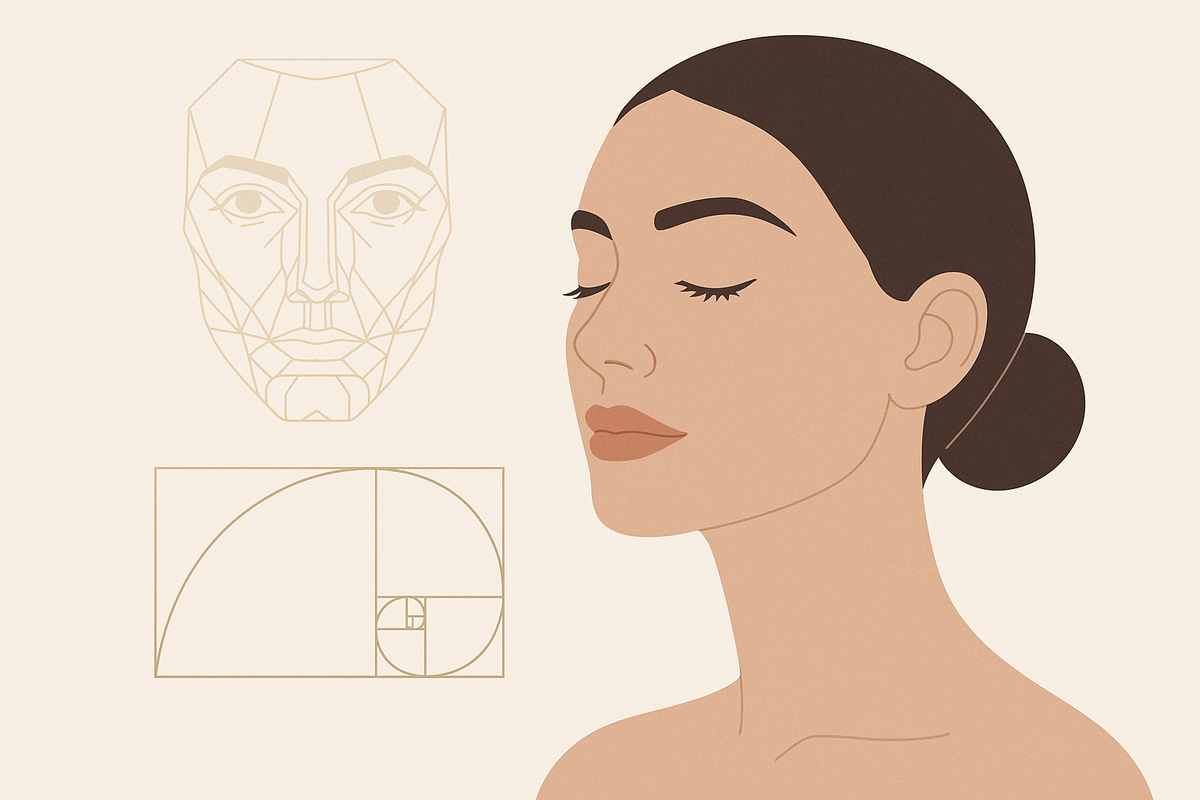
The face is traditionally divided into three equal vertical sections or "thirds":
- From the hairline to the top of the eyebrows.
- From the eyebrows to the base of the nose.
- From the base of the nose to the bottom of the chin.
Balanced vertical thirds create a sense of harmony by ensuring no one section dominates. For example, a disproportionately long lower third can disrupt facial balance and often corresponds to a longer chin or jawline.
In practical terms, professionals such as plastic surgeons and artists measure these thirds during facial assessment to guide procedures or artwork. For instance, if the middle third (eyebrows to nose base) is notably shorter, it might make the face appear top-heavy, whereas a longer lower third can give a heavy or elongated look.
Precise measurement involves using calipers or digital tools to measure distances on frontal images or 3D scans, ensuring accuracy within millimeters. Maxx Report uses AI algorithms to detect these landmarks automatically, minimizing human error.
Facial Fifths: Horizontal Divisions and Eye Spacing
Horizontally, the face is often divided into five equal sections called "fifths". Each eye ideally occupies one-fifth of the total facial width, with the space between the eyes also about one-fifth. This proportion helps establish proper eye spacing and overall facial width balance.
Unequal fifths can make the face appear cramped or too wide, affecting harmony subtly but noticeably. For example, eyes set too close together (less than one-fifth apart) may create a congested look, while excessive spacing can make features seem disconnected.
Eye width and interocular distance are measurable landmarks. Maxx Report’s AI identifies the inner and outer canthi and calculates these distances precisely, delivering a symmetry and proportion report.
Understanding fifths also aids in makeup application and hairstyling, where emphasis or concealment of certain areas can balance perceived proportions.
The Golden Ratio Face: Myth and Measurement
The golden ratio (~1.618:1) is a mathematical proportion found in nature and classical art, often cited as an ideal for beauty. In facial analysis, certain distances—such as nose width to mouth width or face height to width—are compared against this ratio to assess harmony.
However, it’s important to understand that:
- Not all faces with golden ratio proportions are perceived as universally attractive. Perception varies widely among individuals and cultures.
- The golden ratio is a guideline rather than a strict rule. Many attractive faces deviate from this ratio but maintain harmony through other proportional relationships.
- Facial harmony involves many ratios and relationships working together. For example, lip length relative to nose length and chin projection also contribute significantly.
For a deep dive into these proportions, see the comprehensive guide on the Facial Thirds and Fifths and the science behind the Golden Ratio Face.
In clinical and cosmetic settings, golden ratio principles help inform procedures like rhinoplasty or orthognathic surgery, where subtle adjustments aim to move features closer to harmonious proportions.
Section 3: Facial Symmetry vs. Facial Harmony – What Really Matters
Understanding Facial Symmetry
Facial symmetry refers to how identical the left and right sides of the face are in shape, size, and position of features. It has long been associated with attractiveness, health, and genetic fitness.
Symmetry is commonly assessed by comparing:
- Eye alignment and size.
- Nose deviation from center.
- Lip shape and position.
- Jawline matching.
Researchers use bilateral landmarks and calculate symmetry indices, often deriving percentage scores to quantify how balanced a face is. For example, a 90% symmetry score would indicate minor differences between sides.
Symmetry is also linked to evolutionary biology, where it may signal robustness and developmental stability.
Why Perfect Symmetry Is Not the Goal
Despite its importance, perfect symmetry is neither natural nor necessarily the most attractive. Most faces have subtle asymmetries that add character and individuality.
Excessive symmetry can sometimes appear unnatural or mask the dynamic expressions that contribute to a person's appeal. For instance, artificially symmetrical faces may look mask-like or lack the subtle nuances that make faces expressive and engaging.
In fact, certain asymmetries can enhance attractiveness by adding uniqueness, which is often memorable and appealing psychologically.
Facial Harmony Incorporates Symmetry and Beyond
Facial harmony recognizes symmetry as one part of a broader picture. It emphasizes the relationship between features, proportions, and balance rather than just mirroring.
For example, a slightly asymmetrical nose paired with well-balanced cheekbones and lips can still achieve high harmony. The overall impression is of a cohesive face where features complement rather than compete.
Maxx Report’s AI-powered analysis evaluates both symmetry and proportional harmony, giving a more comprehensive assessment of your facial aesthetics. For more on this, check out our guide on How Attractive Is My Face?
By combining multiple metrics, Maxx Report generates a composite score that aims to better reflect perceived attractiveness than symmetry alone.
Section 4: The Role of Canthal Tilt in Facial Aesthetics
What Is Canthal Tilt?
Canthal tilt refers to the angle formed by the inner and outer corners (canthi) of the eyes relative to a horizontal line. It’s a subtle but influential feature in facial perception.
There are two primary types:
- Positive canthal tilt: The outer eye corner is higher than the inner corner, creating an upward slant.
- Negative canthal tilt: The outer eye corner is lower than the inner corner, creating a downward slant.
Quantitatively, positive canthal tilt angles typically range from about 5 to 15 degrees above horizontal, which is often associated with a youthful and vibrant appearance. Negative canthal tilt often corresponds to angles below 0 degrees and can give a more fatigued or less engaged look.
Why Canthal Tilt Matters for Facial Harmony
Positive canthal tilt is generally associated with youthfulness, alertness, and attractiveness. It can enhance the perceived harmony by aligning the eyes with natural facial contours.
This tilt influences how the eyes are framed within the face and interacts with eyebrow shape, eyelid crease, and cheekbone contours. For instance, a subtle positive tilt can make the eyes appear more open and expressive.
Negative canthal tilt may sometimes give a tired or sad appearance, which can affect the balanced look. It can also influence the perceived shape of the eye, making it appear droopy or less symmetrical.
Canthal tilt also has implications in cosmetic procedures such as blepharoplasty or canthoplasty, where surgeons aim to adjust eye corner angles for aesthetic enhancement.
Can Canthal Tilt Be Changed?
While canthal tilt is largely genetic, some cosmetic procedures and facial exercises aim to improve its angle. However, subtle changes are more common, and overall harmony depends on multiple complementary features.
Non-surgical approaches like targeted facial muscle exercises may promote slight lifting effects around the eyes, though scientific evidence is limited. Cosmetic interventions such as canthoplasty can surgically adjust the tilt but involve risks and recovery time.
Makeup techniques like eyeliner placement and eyeshadow can visually simulate a more positive canthal tilt, providing a temporary enhancement without invasive procedures.
Learn more about canthal tilt angles and their typical ranges in our detailed article on Canthal Tilt: The Complete Guide.
Section 5: Understanding the Facial Width-to-Height Ratio (FWHR)
What Is FWHR?
The Facial Width-to-Height Ratio (FWHR) measures the width of the face relative to its height, typically between the upper cheekbones and from the upper lip to the mid-brow area.
Mathematically, it’s calculated as:
FWHR = bizygomatic width / upper facial height
Where:
- Bizygomatic width is the horizontal distance between the most lateral points of the cheekbones.
- Upper facial height is measured from the upper lip (usually the stomion) to the mid-brow (typically the nasion or brow landmark).
Why FWHR Is Important in Facial Harmony
FWHR has been studied for links to perceived dominance, aggression, and attractiveness. Balanced ratios often correlate with a harmonious and appealing facial structure.
A very high FWHR may create a broad, square face, while a low FWHR can make a face appear long and narrow. Both extremes can affect social perceptions; for example, a higher FWHR is sometimes associated with assertiveness, while lower ratios may convey approachability.
In terms of harmony, an FWHR that balances width and height can help avoid disproportionate features that distract from the overall facial unity.
Measuring and Interpreting FWHR
Accurate measurement requires precise landmarks and consistent angles. Maxx Report provides tools and AI-powered analysis to calculate your FWHR and interpret how it relates to your facial harmony.
Using high-resolution frontal photos, Maxx Report detects key points and calculates FWHR with minimal error, providing an objective metric to track changes or improvements over time.
For a detailed explanation, see our posts on FWHR Calculator and FWHR Ratio Science.
Section 6: How Facial Harmony Is Assessed in Modern Face Analysis
From Human Judgment to AI-Powered Precision
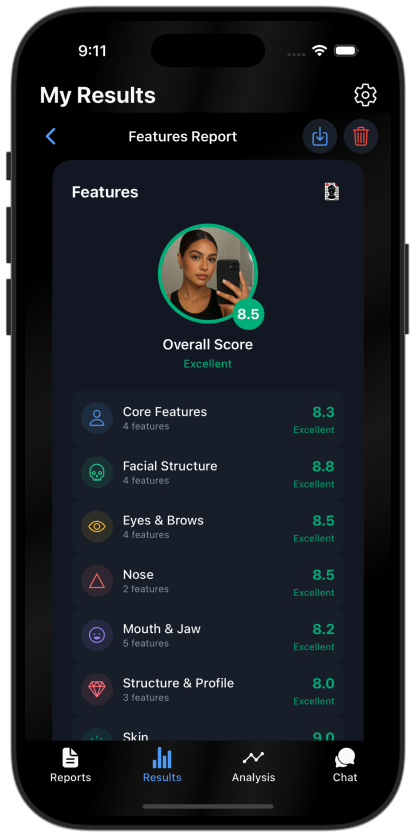
Traditionally, facial harmony was evaluated by artists, plastic surgeons, and aestheticians using visual assessment and manual measurements. Today, AI-driven apps like Maxx Report enhance this process by scanning facial features and calculating numerous metrics quickly.
Maxx Report employs advanced computer vision and machine learning algorithms to detect over 60 facial landmarks in 3D space, enabling robust measurement of proportions, angles, and symmetry.
This automation not only speeds up analysis but enhances accuracy and reproducibility, enabling users to track progress objectively over time.
Key Metrics Evaluated
- Symmetry scores based on 3D landmarks, including subtle deviations in eyes, nose, lips, and jawline.
- Proportion ratios such as the golden ratio face and facial thirds/fifths, with detailed breakdowns of vertical and horizontal balances.
- Canthal tilt angles and eye spacing, quantifying subtle slants and distances that affect expressiveness.
- FWHR and jawline measurements, offering insights into facial breadth and contour sharpness.
- Skin quality and texture analysis, assessing smoothness, pore size, pigmentation, and overall complexion health.
Personalized Glow-Up and Transformation Plans
Beyond analysis, Maxx Report provides tailored recommendations to enhance facial harmony through grooming, hairstyles, skincare, and cosmetic options. This holistic approach treats the face as an integrated whole rather than focusing on isolated features.
For example, if your analysis shows a low canthal tilt but balanced proportions, the plan might suggest makeup techniques and eyebrow shaping to emphasize eye lift. If FWHR is high, subtle shading and hairstyle adjustments can create visual slimming effects.
Maxx Report also tracks progress with before-and-after comparisons, helping users stay motivated and informed about interventions' effectiveness.
Explore Maxx Report’s comprehensive service at Maxx Report to understand your facial harmony deeply and embark on a personalized transformation journey.
Conclusion
Facial harmony is a nuanced concept centered on balance and proportion rather than rigid ideals like perfect symmetry or the golden ratio alone. Understanding facial thirds and fifths, canthal tilt, symmetry, and FWHR provides a scientific framework for appreciating and enhancing facial aesthetics.
Modern AI tools like Maxx Report empower anyone to measure these metrics accurately and receive personalized guidance to improve their natural harmony. Whether you’re curious about "how attractive is my face" or seeking a tailored glow-up plan, embracing the full picture of facial harmony is the key to meaningful transformation.
By appreciating the complexity of facial features and their interrelations, individuals can cultivate a confident self-image rooted in objective insights and personalized enhancement strategies rather than unrealistic ideals.
FAQ
Q: What is facial harmony in simple terms?
A: Facial harmony means that the features of your face—like your eyes, nose, lips, and jawline—are balanced and proportionate, creating a naturally pleasing look rather than focusing on perfect symmetry or one ideal feature.
Q: Is facial harmony the same as facial symmetry?
A: No, facial symmetry refers to how similar the left and right sides of your face are. Facial harmony includes symmetry but also considers how well all features relate and balance each other overall.
Q: What facial proportions are considered most harmonious?
A: Balanced facial thirds (vertical divisions), fifths (horizontal divisions), and ratios close to the golden ratio are considered harmonious. Proper eye spacing and a positive canthal tilt also contribute to harmony.
Q: How do you measure facial harmony?
A: Facial harmony is measured by analyzing various ratios and angles such as facial thirds and fifths, golden ratio relationships, canthal tilt, symmetry scores, and facial width-to-height ratio (FWHR). AI tools like Maxx Report streamline this measurement.
Q: What features matter most for facial harmony?
A: The eyes, nose, lips, chin, jawline, and cheekbones are key features. Their relative sizes, positions, spacing, and angles—especially eye spacing and canthal tilt—play crucial roles in harmony.
Q: Can facial harmony be improved without surgery?
A: Yes, many aspects like grooming, skincare, makeup, hairstyles, and facial exercises can enhance perceived harmony. Maxx Report offers personalized, non-invasive transformation plans based on your facial analysis.